
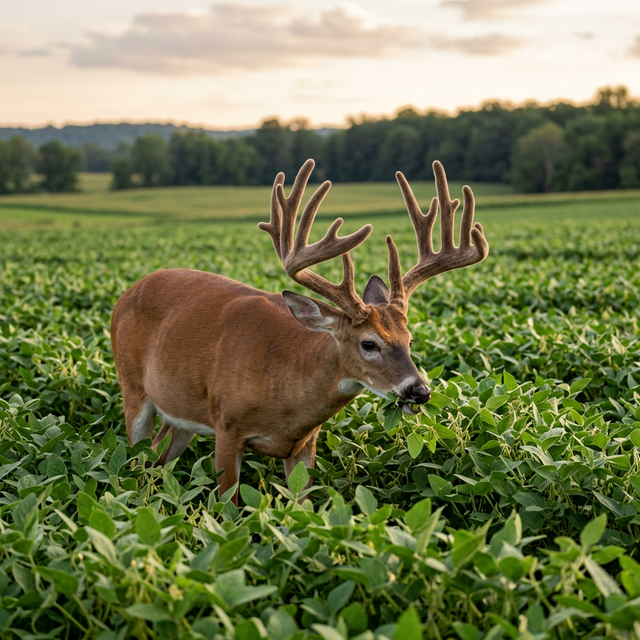
Early Season Whitetail Tactics: Patterning Velvet Bucks
Learn late-summer feeding patterns, how to identify bachelor groups, and capitalize on the intense predictability of early season velvet bucks before the rut changes everything.
Most hunters hyper-focus all their energy and vacation days strictly on the November rut. While the rut is undeniably exciting, it is also pure biological chaos. A rut-crazed buck can cover five miles in a day and act completely unpredictably.
At Wildsnap, we’ve found a vastly more reliable strategy: the first two weeks of the early archery season. Before the chaos of November, mature bucks operate on a highly rigid “Corporate Schedule.” If you put in the grueling summer scouting hours to identify their daily bed-to-food corridors in late August, you have the highest statistical probability of arrowing a giant buck on opening day.
1. The Science of the “Velvet-Shed Spike”
To effectively hunt the early season, you must understand the hormonal clock of a whitetail.
Bachelor Group Dynamics
In the sweltering heat of July and August, a buck’s testosterone levels are at their absolute lowest pointing of the year. This lack of aggression allows them to be highly social and visible.
- The Scouting Strategy: We focus our August surveillance on spending consecutive summer evenings “glassing” large agricultural fields (especially soybeans and alfalfa) from a mile away with spotting scopes. Mature bucks will often feed together in high-visibility zones an hour before dark because their massive, growing velvet antlers are incredibly soft, vascular, and easily injured in thick brush.
The Testosterone Pivot
The “velvet” is a fuzzy membrane that supplies blood and nutrients to the growing bone. The moment the velvet dies and sheds (almost always between September 1st and September 10th in the Midwest), a massive hormonal switch is thrown.
- The Change: As testosterone spikes, the buck’s personality instantly changes. The bachelor group rapidly breaks up due to rising aggression. He becomes solitary, highly nocturnal, and intensely sensitive to human intrusion.
- The Lesson: If you have a buck patterned in late velvet on September 1st, you must hunt him immediately upon the archery opener. That specific pattern has a shelf-life of roughly 5 to 7 days before he completely changes his core area for the fall.
2. Tactical Staging Areas
When opening day arrives, the biggest mistake hunters make is setting up a tree stand directly on the edge of the massive bean field where they watched the buck feeding all summer.
The Staging Window Trap
Mature bucks almost never enter a massive, open agricultural field while the sun is still up, even in the early season. They will let the does and fawns enter first.
- The Intercept: Instead of the field edge, you must hunt the “Staging Area.” This is typically a small, thick opening or a drop in a ridge just 50 to 80 yards inside the timber from the main food source. The buck will leave his deep-timber bed and slowly stage in this thicket, browsing on soft mast (like dropping persimmons, honey locust pods, or wild grapes) until full dark. This staging area is where the Wildsnap team sets our primary early-season interception points.
3. Zero-Impact Entry
Early season woodsmanship is arguably the hardest hunting of the year because the woods are fully leafed out, incredibly dry, and dead quiet.
If you snap a dry branch walking to your stand in the still, 80-degree pre-dawn heat, the sound will travel for half a mile. You must use silent entry routes. Wading up the center of a shallow, sandy creek bed or walking an access trail you meticulously raked bare in July is the only way to slip into a staging area without instantly educating the entire herd.
EARLY SEASON SAFETY: Heat Exhaustion and Ticks
Hunting in 85-degree September heat is an extreme biological strain on the human body, especially when wearing camouflage and a safety harness.
- The Dehydration Trap: We’ve seen deeply experienced hunters suffer severe Heat Exhaustion and dangerous dehydration while waiting in a stagnant, windless treestand. You MUST carry a minimum of 2 liters of water and actively consume electrolyte tablets. If you feel dizzy, safely climb down immediately.
- Insect-Borne Disease: Early season ticks (especially the Lone Star and Deer Tick) are at their absolute peak density. You must treat all exterior clothing with Permethrin spray (which kills ticks on contact) and aggressively check your scalp and belt-line every single night. A velvet buck is not worth contracting a lifelong, debilitating case of Lyme disease or Alpha-Gal syndrome.
Pattern the bachelor group from afar, perfectly identify the timber staging point, and move in with a zero-noise footprint. Early season hunting is a masterclass in patience and woodsmanship.