
Ground Blind Strategies: Staying Concealed at Eye Level
Not every hunt happens 20 feet up in a tree. Master advanced ground blind placement, scent control, and shadow management to get close to mature whitetails at eye level.
When the perfect funnel lacks suitable climbing trees, or when you’re introducing a youth or mobility-impaired hunter to the deer woods, the Ground Blind is your absolute best tactical option.
However, hunting from the ground puts you on the same horizontal plane as a whitetail’s incredibly tuned eyes and nose. Defeating a mature deer at eye level is arguably the ultimate challenge in hunting. At Wildsnap, we’ve found that most ground blind failures aren’t due to the camouflage pattern of the blind itself, but rather critical errors in “visual signature” and location management.
The “Black Hole” Effect and Light-Bleed
When you set up a ground blind, you are essentially creating a dark, enclosed cave in the middle of a forest. Deer notice “black holes” if you don’t manage them properly.
Mastering Shadow Management
Your interior must be cast in total shadow to prevent a deer from seeing your silhouette.
- The Rule of One: We strongly advocate for leaving only exactly one shooting window open. If you open a window in the front and a window in the back, the light passes straight through, and you will be perfectly silhouetted against the rear opening. Keeping the rear and side windows zipped tight prevents this “light-bleed.”
- The Black-Out Look: Do not wear your standard woodland or digital camouflage inside a blind. The inside of the blind is black. You need to wear a matte black hoodie, a black face mask, and black gloves. This ensures your face and hands disappear completely into the dark void of the blind’s interior.
Technical Brushing-In: Breaking the Silhouette
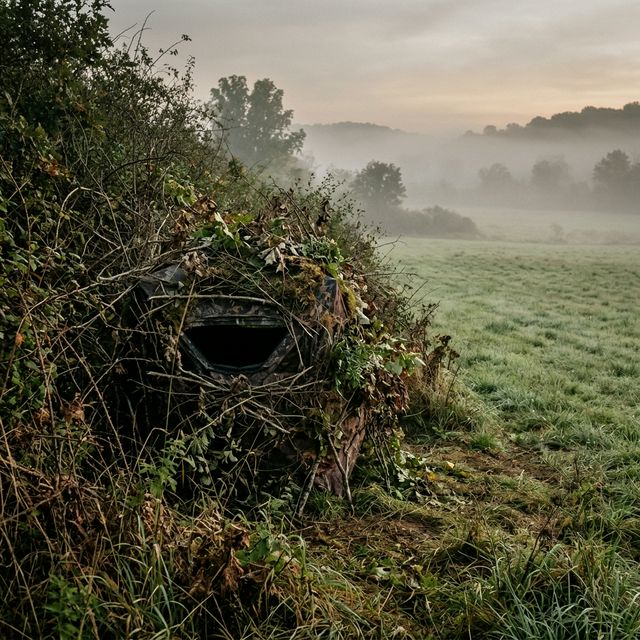
A brand-new ground blind plopped in the middle of a cut cornfield looks incredibly unnatural. To a mature buck, it looks like a deadly, giant boulder that appeared overnight. You must break up the geometric outline.
1. Vary the Texture
Use heavy snips or a folding saw to gather local vegetation—downed logs, thick cedar boughs, corn stalks, and tall grasses. Lean this debris heavily against the blind to break up the hard, unnatural 90-degree corners. The blind should look like a natural deadfall or brush pile.
2. Bruting the Roofline
The most glaringly unnatural feature of a pop-up blind is the flat, horizontal roof. It is the #1 way deer spot a blind from a distance. Use long, overarching branches to drape across the roofline, breaking up the geometric box shape.
3. Timing Your Setup
If possible, do not set up a blind the day you intend to hunt. Try to set it up a month before the season opens. Deer are hyper-aware of changes in their environment. If you set it up early, they will treat it as a new, harmless feature of the landscape and grow completely accustomed to walking past it by opening day.
CRITICAL SAFETY: Exhaust and Mechanical Broadheads
The Silent Killer: Late-season ground blind hunting is incredibly cold, prompting many hunters to use portable propane heaters inside the tent. Carbon Monoxide (CO) Poisoning is a lethal, silent risk in a confined, poorly ventilated space.
- Always ensure at least two high-up window flaps are cracked open to allow for a continuous draft of cross-ventilation.
- If you begin to feel prematurely tired, dizzy, nauseous, or develop a sudden headache, turn off the heater and exit the blind immediately.
Broadhead Deployment: If you plan to shoot arrows through the “shoot-through” mesh windows of your blind, you absolutely must use a fixed-blade broadhead. Expandable or mechanical broadheads will catch on the mesh and deploy prematurely upon contact, drastically altering the arrow’s flight path and resulting in severe injury to the animal instead of a clean harvest.
The Scent Control Challenge
Hunting from a tree stand helps your scent blow over the top of a deer’s head. On the ground, your scent blows directly into their nose.
- Keep the wind in your favor: A blind does not contain your scent. You must place the blind so the prevailing wind blows your scent into a non-deer area (like a steep ravine, a deep waterway, or an open pasture where deer aren’t traveling).
- Control the ground: Rake all the dry crunchy leaves and debris out from underneath the blind down to the bare dirt. This ensures that you can adjust your footing silently when a deer approaches within bow range.
Frequently Asked Questions (FAQ)
Can deer see the black mesh on the windows? Deer generally don’t focus on the mesh itself; they focus on the stark contrast between the camouflage fabric and the solid black hole of an open window. If you leave the sheer shoot-through mesh up, it actually helps reflect the surrounding camo pattern softly, hiding the black hole better than a fully open window.
Where is the best place to set a ground blind? Tuck the blind into existing cover. The best locations are backed up against thick brush, tucked into the V of a large, multi-trunk oak tree, or embedded in a fence line. Never place it fully exposed in the open if you can avoid it.
Ground hunting is intimate, intense, and visceral. When a mature whitetail steps within 20 yards at eye level, the margin for error is zero. Master the shadows, respect the wind, and prepare for an encounter that will put your heart right in your throat.