
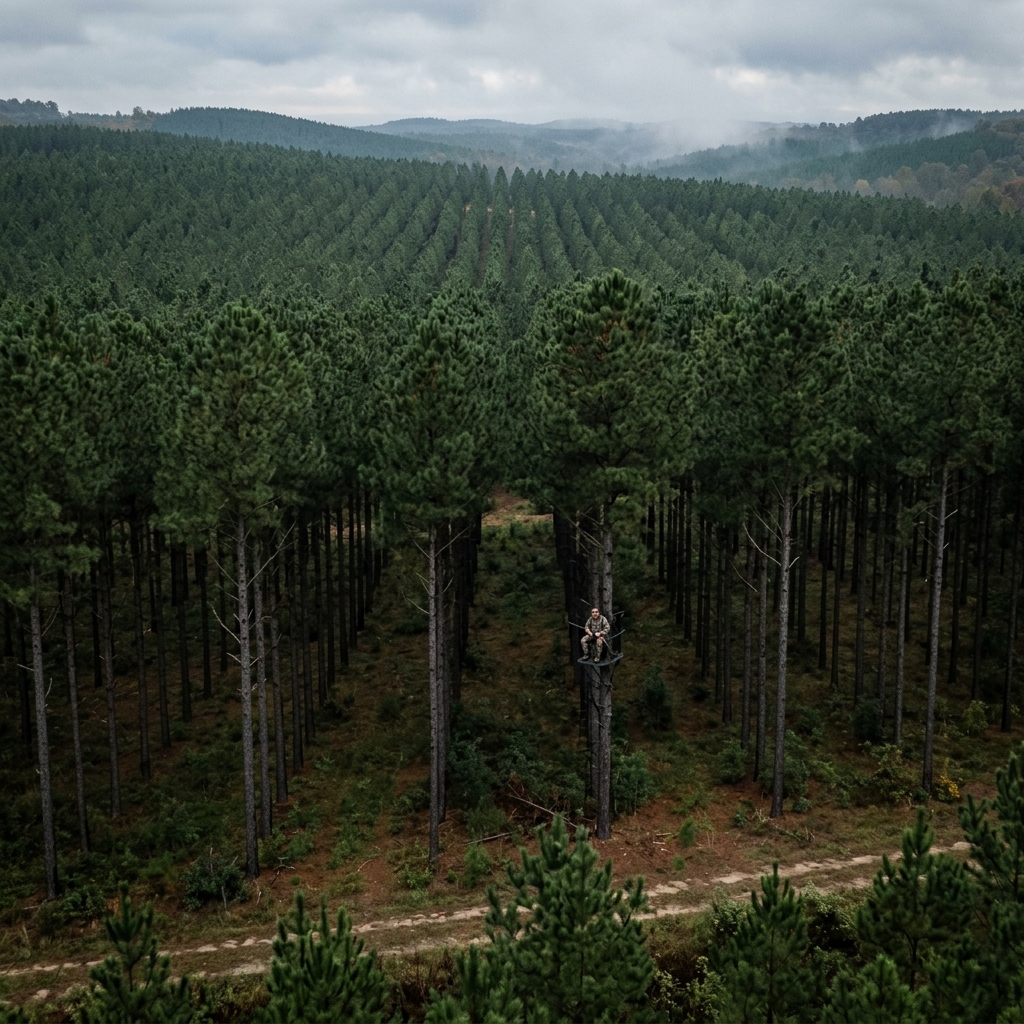
Hunting Pine Plantations: Cracking the Conifer Monoculture
Massive, endless pine thickets can either be a biological desert or an absolute whitetail goldmine. Learn exactly how to identify the right age class of trees and tactically hunt the 'thinning rows' like a seasoned pro.
In massive parts of the country, specifically throughout the deep Southern United States, commercial Pine Plantations dictate the absolute entirety of the hunting landscape.
To the untrained eye of a Midwestern hunter used to beautiful rolling oak ridges and massive agricultural fields, these millions of acres of perfectly spaced, rigidly planted conifers look exactly like a terrifying, sterile “monoculture” where absolutely nothing is capable of surviving.
But to a savvy, heavily nuanced whitetail hunter, a massive pine thicket is not a desert; it is an impenetrable, highly structured fortress. If you genuinely know how to expertly “read” the physical age of the timber stand and surgically locate the deeply hidden browse, you can exploit these massive properties for some of the most highly consistent, deeply secluded hunting of your entire life.
1. The Biological Timeline: Pine Age Classes
Do deer actually eat pine needles? Generally, absolutely not. Conifer needles are incredibly low on the list of biologically preferred, nutritional deer foods.
The entire mathematical value of a massive pine plantation does not physically lie within the trees themselves, but explicitly heavily depends on the amount of sunlight physically hitting what lives under them.
- The Early Years (Age 1-5): This is the extreme food phase. Before the tiny pine trees grow tall enough to close their canopy, massive amounts of direct sunlight violently hit the disturbed soil. This explicitly triggers a massive explosion of high-protein weeds, thick blackberry briars, and hardwood saplings growing viciously between the rows. It is an absolute, massive all-you-can-eat buffet for the local deer herd.
- The Dead Zone (Age 10-15): Once the pines reach roughly 20 feet tall, their thick upper branches violently close the canopy, completely and aggressively shading out absolutely everything on the dark forest floor. The briars deeply die off, creating a sterile “biological desert” covered only in dead, brown needles. This specific age class holds zero massive food value and is exclusively only used by deer as a high-speed, invisible travel corridor to get somewhere else.
2. How Do You Tactically Hunt a Dense Pine Forest?
Because the landscape is so overwhelmingly, confusingly uniform, the absolute key to killing a buck in a sea of identical pines is aggressively finding micro-diversity.
- The ‘Thinning Row’ Intersections: In commercial timber operations, logging companies will mechanically “thin” a crowded stand roughly every 10 to 15 years, brutally clear-cutting every 4th or 5th row to allow the remaining trees room to expand. These massive, completely straight, miles-long “lanes” quickly brush up with new green growth from the sudden sunlight. These lanes immediately become the absolute ultimate, high-speed travel corridors for cruising bucks. You must aggressively set your tree stand exactly at the geometric intersection where a fresh thinning row violently crosses a known trail leading to a dense bedding area.
- The Hardwood Edge Transition: Deer absolutely love to bed deep in the thick, visual safety of the impenetrable pines during the day, and then reliably transition into the adjacent, open hardwood creek bottoms (full of dropping white oaks and hickories) to heavily feed in the evening. Siting directly on the stark, obvious “transition line” where the dark pines abruptly meet the open hardwoods is the absolute most classic, lethal Southern hunting tactic in existence.
- The Perimeter Fire Breaks: The vast majority of mature commercial plantations are bordered tightly by massive, plowed dirt “fire breaks” to prevent devastating wildfires. These long, disturbed strips of exposed earth are heavily exposed to sunlight and often wildly grow lush, thick green native grass and white clover, effectively acting as a massive, natural, miles-long food plot curving entirely around the dark timber.
ACCESS SAFETY: The Grid-Layout Navigation Hazard
Hunting perfectly uniform, massive monoculture pine forests presents a completely unique, highly disorienting navigational danger that open-woods hunters rarely encounter.
- The Visual Illusion: Because every single tree, every single row, and every single acre of a 5,000-acre pine plantation looks absolutely, terrifyingly identical, the human brain rapidly loses all sense of physical depth perception and cardinal direction. There are no massive, unique “landmark” oak trees or strange rock formations to desperately guide you.
- The GPS Mandate: It is incredibly, shockingly easy to simply turn around to track a blood trail in the dark, walk 100 yards off the thinning row, and become instantly, violently lost in a sea of identical green trees. You absolutely must carry a dedicated, downloaded digital mapping application (like OnX or basemap) with full offline satellite capabilities, and rigidly drop a hard GPS waypoint exactly on your parked truck the very second you step out of the door.
Do not ever foolishly overlook the massive pines. They might not be nearly as romantic or visually beautiful in pictures as an old-growth, mossy oak forest, but their dense, intimidating cover heavily holds the absolute biggest, oldest deer that the other lazy hunters are entirely missing. Get completely in the thicket, trust your GPS, and stay violently patient.