
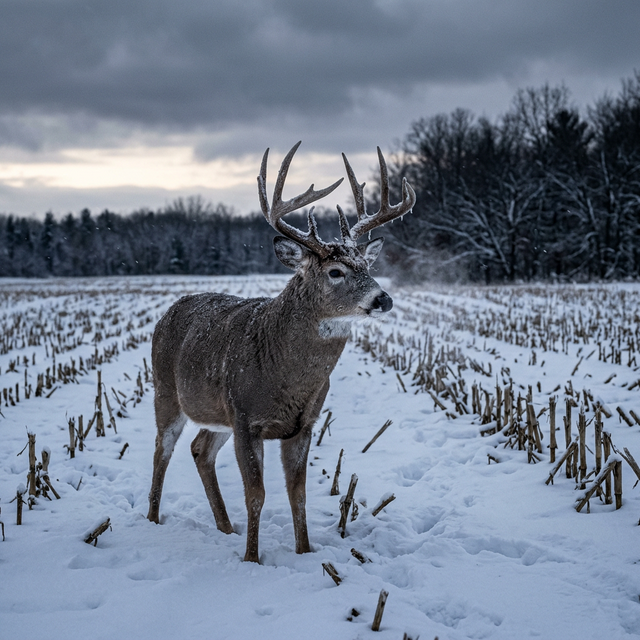
Late Season Whitetail Tactics: Finding High-Energy Food Sources
When the rut ends and winter sets in, survival becomes the only priority. Learn how to identify and hunt the high-energy food sources mature bucks rely on in December and January.
The late season is uniquely brutal. At Wildsnap, we’ve found that December and January offer the most predictable patterns of the entire year because the biological drive for reproduction has been replaced by the primal drive for Survival. To tag a giant in the snow, you must stop hunting the “rut” and start hunting the Internal Furnace.
The Glycemic-Shift and Metabolic Fuel
After the rut, a mature buck has lost up to 25% of his body weight. He is in a massive caloric deficit and is chemically hard-wired to crave high-carbohydrate food.
- The Turnip-Dig: In our experience, summer clover plots will go “dead.” You must shift to starch-heavy sources: standing corn, cut beans, or brassicas. Watch for “Snow-Scuffing”—where deer use their hooves to dig out starch-rich tubers or leftover grain.
- The 1 PM Window: Cold weather kills movement at dawn. On sub-zero days, deer stay in their Thermal Bedding (cedars or south-facing pine groves) during the morning to stay warm. They will only move during the warmest part of the day (1 PM to 4 PM) to recharge their caloric furnace.
Tactical Bed-to-Feed Funnels
In late winter, every step a deer takes costs calories. They will travel the shortest possible distance to reach food.
- Micro-Funnels: Find a tight line of cover—a single fence row or a cedar-drainage—that connects a bedding sanctuary to a food source within 150 yards. This “Short-Walk” is where a mature buck will appear in daylight.
LATE SEASON SAFETY: Frostbite and Ice Rigidity. Extreme cold is inclusive of physical hazards. You must wear high-loft insulation and use chemical hand-warmers; we’ve seen hunters suffer Stage 1 Frostbite on their extremities during a single 3-hour sit. Furthermore, never cross frozen waterways without an Ice Spud or trekking poles to verify thickness. The “4-Inch Rule” is mandatory; if the ice has a “honeycomb” texture from a recent thaw-freeze cycle, it has lost its structural rigidity and is unsafe.
The late season is a game of caloric math. Find the fuel, stay warm, and wait for the cold-front that makes a survivalist step into the sun.