
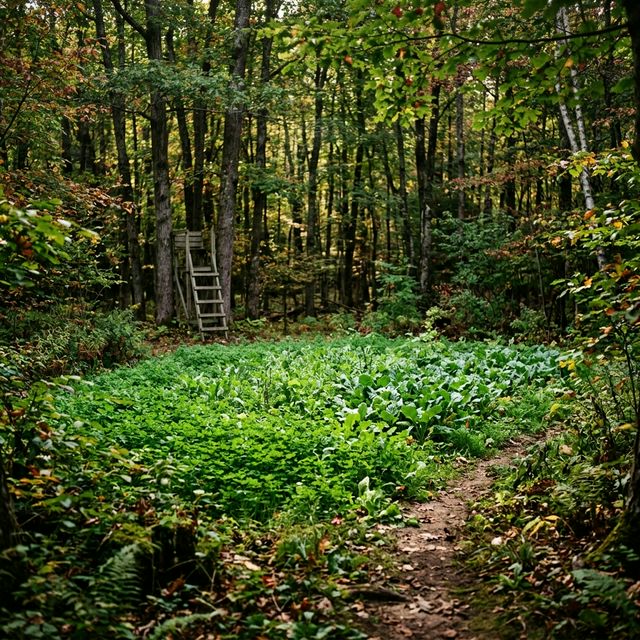
How to Build and Hunt Over Lethal 'Poor Man' Micro-Plots
You absolutely do not need an expensive 60-horsepower tractor to drastically improve your local deer habitat. Learn exactly how to scientifically create highly effective micro-plots deep in the timber using basic hand tools and simple no-till methods.
Many amateur hunters fiercely dream of violently manicured, vast 10-acre fields of lush soybean agriculture, but for the vast majority of us managing smaller public-bordering parcels or operating on strictly limited budgets, a strategic “Poor Man” food plot is the definitive, tactical solution.
At Wildsnap, our habitat teams have violently carved these massive, highly effective micro-plots directly into the teeth of the thickest, darkest timber using absolutely nothing more than a heavy gas-powered backpack leaf blower, a rigid steel landscape rake, and a perfectly timed backpack of seed. These tiny “kill plots” mathematically do not serve as massive herd-sustaining nutrition; instead, they function entirely as a highly precise tactical destination specifically designed to firmly stop a cruising buck dead in his tracks for exactly 30 seconds at 20 yards.
1. How to Make a Jungle Food Plot Without a Tractor
The absolute essential key to a successful no-equipment wilderness plot is maximizing direct Seed-to-Soil Contact. If the seed touches a dead leaf instead of dirt, it will die.
- Strategic Sunlight Exposure: You must actively seek out specific gaps in the heavy timber canopy where direct sunlight physically hits the dark forest floor for a minimum of 4 hours a day exactly during the late summer. We have scientifically proven that abandoned logging landings, old fire breaks, or dead ash-tree clearings are absolute prime candidates.
- The “Blow and Rake” Method: Use a 4-cycle gas leaf blower to violently violently remove absolutely every single dead leaf from the entire targeted quarter-acre area. You mathematically need to see 100% bare, dark mineral soil. Use a steel landscape rake to scratch the hard dirt. If you hear the steel tines aggressively “clinking” directly on the hard dirt or rocks, you are doing it perfectly.
- Chemical Soil Amendments: Whitetails fiercely desire high-protein lush forage, but premium clover absolutely will never grow in highly acidic, toxic “pine needle” dirt. At the bare minimum, you must aggressively pack in heavy bags of pelletized lime explicitly to chemically boost the soil’s pH level closer to neutral.
- The Boot Pack Germination: Once you manually broadcast your tiny seed directly onto the bare dirt right before a major rainstorm, you must physically walk the entire plot. In our physical experience, aggressively using your heavy rubber boots to firmly “press” the tiny seeds directly down into the soft mud is vastly more effective than any light raking for guaranteeing high germination rates.
2. Choosing the Best Seed for Deep-Timber “Kill Plots”
In an aggressively low-sunlight, no-till, highly acidic forest environment, you absolutely need tough, “throw and grow” seed varieties that thrive on the forest floor:
- White Ladino Clover: The undisputed gold standard for deeply shaded micro-plots. It is a hearty perennial, meaning it will aggressively bounce back year after year flawlessly if you chemically keep the competing local weeds back.
- Winter Cereal Rye: We affectionately call this the absolute “Poor Man’s Secret Weapon.” It will reliably rapidly germinate in almost absolutely any terrible soil condition (even simply broadcast explicitly on top of frost) and stays vibrantly green well into the freezing late season when everything else is totally dead.
- Brassicas (Radishes and Turnips): Excellent for providing a massive, highly visible “green-up” that rapidly mathematically draws deer explicitly during the late-October transitional phase.
PRESSURE MANAGEMENT: The Staging Strategy
Because these specific tactical plots are incredibly small, they are violently sensitive to heavy human hunting pressure. We have learned the agonizing hard way that you absolutely cannot casually “over-hunt” a kill plot.
- The Ambush Setup: Never set your stand physically directly over the middle of the plot to proudly shoot feeding does. Position yourself precisely 40 yards downwind on the primary access trail. Use the plot entirely as a distinct “destination” for mature bucks to quickly stop and scent-check for local does deeply before they head exactly out to the larger, dangerous agricultural fields long after dark.
- Silent Access: If you loudly crunch through 200 yards of dry oak leaves to blindly get to your tree stand, the micro-plot is instantly useless. We rigorously recommend physically rake-cleaning a 2-foot-wide silent dirt path directly to your stand tree at least two months in advance.
Habitat management mathematically is a massive labor of intense love. With a little heavy sweat equity and the precisely correct timing, a tiny quarter-acre patch of screaming green deliberately planted in a vast sea of brown timber absolutely can become the single most productive twenty yards on your entire property.