
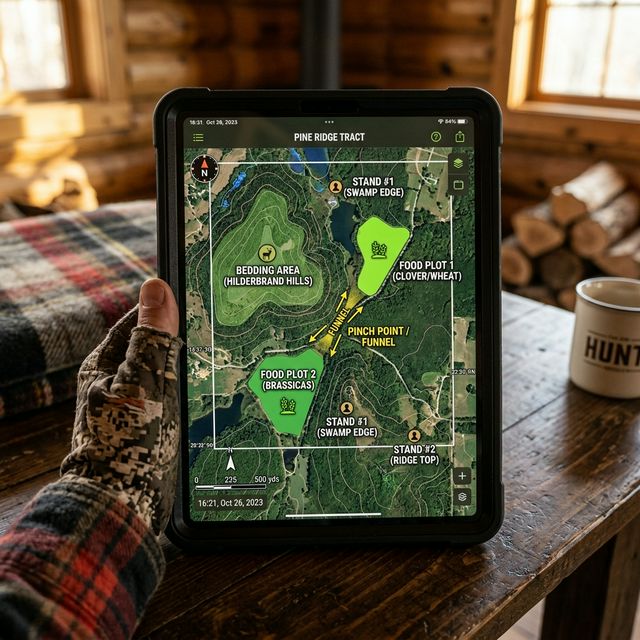
E-Scouting for Whitetails: Discovering Hidden Gems on Mapping Apps
Before you ever set foot in the timber, the hunt is won on your screen. Master the highly technical art of e-scouting to identify high-traffic deer corridors using digital mapping tools.
In the modern era of hunting, “boot leather” scouting alone is no longer enough to consistently kill mature whitetails, especially on heavily pressured public land.
Digital scouting, universally known as E-Scouting, has completely revolutionized how aggressive hunters dissect the woods. Utilizing incredibly powerful, satellite-driven tools like onX Hunt, HuntStand, or Gaia GPS, hunters can perfectly analyze terrain funnels, identify specific vegetation transitions, and confirm highly debated land ownership boundaries without ever leaving the driver’s seat of their truck.
At Wildsnap, we firmly believe that the most successful, high-stakes hunts are won in July and August—during the quiet, meticulous hours spent studying individual pixels on a laptop screen to identify the absolute perfect tree.
1. Building the Layers: What to Look For
E-scouting is not just opening Google Earth and vaguely looking for a pretty patch of green trees. It is the highly technical process of identifying the biological intersection of thick security cover, prime food, and favorable topography.
To get a definitive, 3D picture of the hunting landscape, you must aggressively stack specific data layers on your app:
- High-Res Satellite Imagery (Leaf-Off): Always toggle to “Leaf-Off” or winter imagery if the app supports it. This allows you to literally see through the canopy to identify the exact hardwood floors, dense cedar thickets, and tiny, hidden swamp clearings that are entirely invisible in summer imagery.
- Topographic (Topo) Lines: Topo lines are the absolute holy grail of e-scouting. Where lines are tight together, the terrain is incredibly steep. Where they widen out, the terrain is flat. You are specifically looking for “Benches” (small flat shelves on a steep hill) and “Saddles” (dips in a ridgeline) because deer are lazy—they will always travel the path of least physical resistance.
- Lidar / Timber Cuts: Advanced apps now offer Lidar and historical timber-cut data. A 5-year-old clear-cut is an impenetrable jungle of briars and saplings. Mature bucks will specifically bed on the very edge of these cuts because it offers unmatched visual and scent security.
2. Identifying the Bedroom: The Biological Why
Mature whitetail bucks only look for two critical things when choosing a bed: downwind scent superiority and visual advantage.
When staring at your map, look for the following “Red Zone” bedding features:
- Leeward Benches: If the prevailing wind blows from the West, a buck will almost always bed on the East side of a steep ridge (the leeward/downwind side), about 1/3 of the way down from the top. He will face downhill, watching his visual blind spot, while the wind blowing over the top of the ridge brings the scent of anything approaching from behind him directly to his nose.
- Swamp Islands (Oxbows): Look for tiny, dry, elevated patches of ground totally surrounded by a meandering river or thick cattail swamp. Accessing these geometric “islands” requires a human to wear chest waders and make massive amounts of noise splashing through the water. Bucks know this, which is exactly why they live there.
3. Planning the “Zero-Impact” Access
Finding the deer is only 20% of the battle. The other 80% is figuring out how to get to that exact spot without the deer knowing you are in the same zip code.
While satellite imagery identifies the food, Terrain Relief tells you how the wind will move.
- The Thermal Drop: You must plot your walking route based on thermals. As the sun sets and the air cools, the heavy, cold air actively sinks down the side of the hills into the valleys. If you walk up a ravine in the evening, your scent is being continuously blown directly down the hill ahead of you.
- Topographic Shadows: Use the measurement tools to draw an entry route that utilizes “Topographic Shadows.” Walk entirely up the backside of a steep ridge, only cresting the top exactly where your tree stand is located. If you walk along the top of a wide-open ridge, every deer in the valley below can see your silhouette against the sky from half a mile away.
E-SCOUTING LAWS: Property Boundaries and Digital Accuracy
The most vital layer on any hunting app is the Public/Private Land Boundary layer.
- The GPS Drift Warning: While onX and HuntStand are incredibly accurate, they are not legal land surveys. GPS satellites can occasionally suffer from “drift,” making a property line on your phone appear 30 feet away from its true physical location in the woods.
- Trespassing Reality: If the app says you are on public land, but you cross a rusted barbed-wire fence with faded “No Trespassing” signs nailed to the trees, respect the physical signs. The local game warden will not accept “my app said I was legal” as a valid defense for criminal trespassing. Always give a wide, 50-yard buffer to any questionable digital boundaries to avoid ruining your hunt with a massive fine or an angry landowner confrontation.
Digital map analysis is the defining, foundational skill for the modern public land woodsman. If you combine your high-level digital data with aggressive, boots-on-the-ground verification, you will confidently find yourself in the “red zone” more consistently than ever before.