
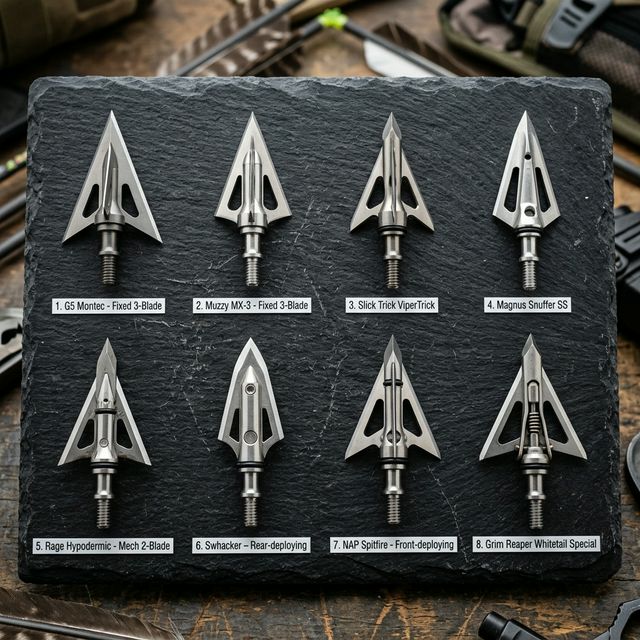
Fixed Blade vs. Mechanical Broadheads: The Ultimate Penetration Guide
Fixed vs mechanical broadheads compared by KE, tuning, cut diameter, and reliability. Pick the head that matches your draw weight and guarantees pass-throughs.
The broadhead is the terminal end of your entire archery system. A $2,000 bow and perfect release still fail if the head glances, folds, or stalls under the hide. The fixed-versus-mechanical argument is usually framed as tribal loyalty. It should be framed as physics: kinetic energy, momentum, tuning skill, and the animal in front of you.
There is no universal winner. There is a head that matches your setup and that you have proven on targets and animals.
Fixed Blades: Simplicity and Bone Truth
Fixed blades have no moving parts. Edges stay deployed from the shot through the exit.
Two tip philosophies:
- Cut-on-contact: Blade edge meets hide immediately—maximum penetration for lower-energy bows, traditional gear, and youth setups.
- Trocar/chisel tips: Solid point designed to break bone; trailing blades cut after the tip wins the collision.
Reliability is the selling point. No rubber bands, no deployment levers, no “failed to open” stories. A stout single-bevel or tough multi-blade fixed head that hits shoulder often keeps going when lighter mechanicals stop.
Trade-off: fixed blades act like wings. If your arrow leaves the bow with yaw, wind plane will steer it. You must broadhead-tune if you expect accuracy past 30 yards.
Mechanicals: Flight and Wound Channel
Mechanical (expandable) heads fly with blades tucked, so they usually match field-point impact with less tuning drama. That accuracy advantage is real for hunters who stretch shots to 40–50 yards from stands.
On impact, modern heads often open to 2–2.5 inches of cut—larger than many 1–1.25 inch fixed heads. Larger holes generally mean louder blood trails in brush and at night.
Cost of admission: deployment energy. Opening blades spends kinetic energy that would otherwise drive penetration. Low-poundage bows and ultra-light arrows pay that tax and sometimes stop short of a full pass-through.
Match Head to Kinetic Energy and Arrow Weight
Use honest numbers, not catalog FPS fantasies.
Rough guidance many bow techs use:
- Under ~55 lb draw or under ~400 grain arrow: Favor fixed cut-on-contact or compact mechanicals with modest cut diameters.
- 55–70 lb with 400–500 grain finished arrows: Either style can work; prioritize proven penetration on bone tests.
- Heavy arrows / high FOC: See heavy vs light arrows and FOC—momentum helps both designs, especially mechanicals that must open first.
Calculate KE if you like, but momentum and arrow mass often predict penetration better on angled hits.
Tuning and Practice Protocol
Before season:
- Paper or bare-shaft tune until tears are acceptable.
- Broadhead-tune fixed blades at 20, 30, and 40 yards.
- Shoot at least a dozen broadheads into a dense target—not one lucky bullseye.
- Replace blades after any dirt or practice impact if edges dull.
Mechanicals still need practice. Confirm blades lock, O-rings/bands are fresh, and the head spins true on the arrow. A bent ferrule that “groups with field tips” at 20 can walk at 40.
Blood Trails and Real-World Forensics
Field recovery data often favors large mechanical cuts for visible blood—especially double-lung hits with exit holes you can cover with a fist. Fixed blades can kill just as dead with quieter trails if the cut is smaller but the angle is perfect.
Your job after the shot is the same either way: mark, wait appropriately, and trail with discipline. Use expert blood trailing tips and know meat spoilage limits if recovery runs overnight.
Safety: Wrenches, Not Fingers
Broadheads are sharper than kitchen knives out of the package.
- Always use a broadhead wrench to install or remove heads
- Cap heads in a quiver; never loose in a pack pocket
- Seat heads fully—partial threads cause catastrophic failure on release
- Keep replacement blades in original packaging until needed
A slipped bare-hand install in a stand is a common way to end a season in the ER.
Hybrid and Single-Bevel Options
The market is not binary anymore:
- Hybrids combine a fixed tip with deployable rear blades
- Single-bevel fixed heads rotate through bone and are popular with traditional and heavy-arrow setups
- Compact mechanicals (smaller cut, stronger deployment) exist for marginal energy setups
Test what you will hunt. A 40-yard bean-field shot and a 18-yard timber shot through brush ask different questions.
Crossbow shooters should also weigh bolt weight and speed—see crossbow vs compound bow—because ultra-fast light bolts can open big mechanicals then stall.
Field Testing Protocol Before Opening Day
Do not let the first broadhead of the year be the one in a deer.
- Weigh three finished arrows with broadheads—reject outliers over a few grains
- Shoot a 3- or 4-arrow group at 20, 30, and your max distance
- Compare to field points; adjust rest/sight until they agree or you know the offset
- Shoot into dense targets at realistic angles—quartering foam if available
- Inspect blades for burs; replace before hunting
- Confirm quiver clearance so blades do not nick vanes in the stand
Record draw weight, arrow length, total grains, and head model in a notebook. When something fails in November, you have a baseline instead of folklore. If you change rests, peeps, or point weights midseason, repeat the protocol. “It was fine in September” is not a tune.
Bone Hits and Exit Strategies
Shoulder hits happen. Fixed heads with stout ferrules and cut-on-contact or chisel tips generally fare better than large mechanicals when energy is marginal. If you choose mechanicals, pick designs with strong deployment and consider slightly heavier arrows. After any questionable hit, wait longer, mark carefully, and trail with a partner when possible. Penetration insurance is cheaper than a lost deer.
Practice an ethical pass: if the only lane is hard quartering-to through the shoulder, wait. Broadhead debates matter less than shot selection. The best head in your quiver cannot fix a low-percentage angle taken out of excitement.
Matching Heads to Terrain and Shot Distance
Timber hunters who live at 15–25 yards can prioritize forgiveness and penetration—stout fixed or compact mechanicals. Open-field hunters stretching to 40+ yards often value field-point flight from mechanicals, provided arrow mass supports deployment.
List your last three seasons of shot distances. If 80% were under 30 yards, do not buy a head optimized for 60-yard western shots. If you hunt CRP edges and bean corners, practice those distances monthly with broadheads, not only field points.
Crosswinds matter more with fixed blades. On windy ridge sits, a well-tuned mechanical or a compact fixed with less surface area can reduce plane. Still, never use wind as an excuse for a 45-yard fling at a walking deer. Pass, tighten the max range, and wait.
Keep two matched arrows ready in the quiver and a third as backup. After a pass-through into dirt, retire that head from hunting use until blades are replaced and the ferrule is inspected for bends.
Storage, Travel, and Pre-Hunt Checks
Broadheads dull in quivers against each other if caps are poor. Use quality hoods and inspect before every hunt. Travel cases should keep points from bending ferrules. A bent mechanical ferrule that still “looks fine” can open unevenly.
Pre-hunt checklist:
- Blades sharp enough to shave or pass a rubber-band cut test
- Ferrules straight when spun
- Heads torqued with a wrench, not fingers
- Practice arrow impacts match hunting arrows within your tolerance
If you switch between fixed and mechanical midseason, retune and rezero. Assuming they share impact is how clean practice turns into a shoulder wound at 35 yards.
Frequently Asked Questions
Which is more ethical, fixed or mechanical?
Neither. Ethical is a sharp head, adequate energy, a high-percentage shot, and a disciplined recovery. A dull fixed blade is less ethical than a sharp mechanical used within its limits.
Why did my mechanical bounce or fail to open?
Possible causes: hit brush in flight, skimmed a rib angle, low energy, weak retention band, or a head design not meant for your speed/weight. Inspect and change setups before the next hunt.
Do I need to retune when switching brands?
Yes. Different blade surface area and weight shift point-of-impact. Retune and verify grouping every time.
How often should I replace blades?
After any practice impact into a target, after hitting dirt/bone, or whenever a fingernail catches a burr. Fresh edges cut cleaner and penetrate better.
Can I shoot mechanicals out of a traditional bow?
Usually a poor match. Low stored energy and slower arrows favor cut-on-contact fixed designs.
Pick the head that passes through the deer you actually hunt with the bow you actually shoot. Tune it, practice it, and keep it razor sharp—marketing slogans do not open arteries.