
High Wind Whitetail Tactics: Do Deer Actually Move When the Trees Sway?
Do not let a windy forecast keep you trapped on the couch. Learn the high-level biological tactics to identify protected 'leeward' bedding areas and successfully hunt mature whitetails when the wind is screaming.
For generations, the most pervasive, universally accepted myth in deer hunting has been that when the wind blows over 15 MPH, deer get “spooked,” completely hunker down in thick brush, and absolutely refuse to move for days at a time. Therefore, hunters assume a windy forecast means they should sleep in.
At Wildsnap, our extensive cellular camera data and GPS collar tracking tell a drastically different, highly tactical story: Deer absolutely move during high wind events, but they dramatically change their geography.
Understanding exactly why they move and where they go is the absolute key to turning a miserable, blustery day into the most successful hunt of your entire season.
1. The Sensory Blackout
To understand a whitetail’s high-wind behavior, you must first understand their biology. A mature buck’s survival is entirely dependent on his three primary defense mechanisms: his nose, his ears, and his eyes.
When a massive cold front pushes through and the wind is screaming at 25+ MPH, the woods become absolute chaos.
- Auditory Blackout: The deafening sound of swaying trees, snapping branches, and roaring leaves completely eliminates a deer’s ability to hear a predator’s footsteps.
- Olfactory Chaos: The swirling, violent wind currents completely destroy a deer’s ability to accurately pinpoint the specific directional location of a scent.
- The Reaction: A mature buck feels incredibly vulnerable during this sensory blackout. His immediate survival strategy is not to stop moving; it is to physically relocate his body to a specific “quiet pocket” of the topography where he can immediately regain his tactical sensory advantage.
2. The Leeward Ridge Strategy
The absolute golden rule of high-wind hunting is topographic manipulation. You must aggressively hunt the Leeward Side.
- The Setup: If a vicious, sustained wind is blowing hard out of the Northwest, do not waste your time sitting on the wide-open top of a ridge or forcing a hunt on a completely exposed agricultural field edge.
- The Leeward Drop: You must drop down onto the South or East-facing slopes—the “leeward” side that is physically protected from the direct, punishing force of the wind by the mountain itself.
- The Bedding Vortex: Mature bucks will aggressively tuck into the thickest cover they can find on this leeward ridge, exactly one-third of the way down from the crest. In this calm, highly protected pocket, the deafening roar of the wind is muted, allowing them to rely on their ears again. More importantly, the intense wind rushing over the top of the ridge above them creates an aggressive thermal vacuum that actually pulls the scent from the entire quiet valley floor directly up the hill and straight into their nose.
3. The Ground Hunting Advantage
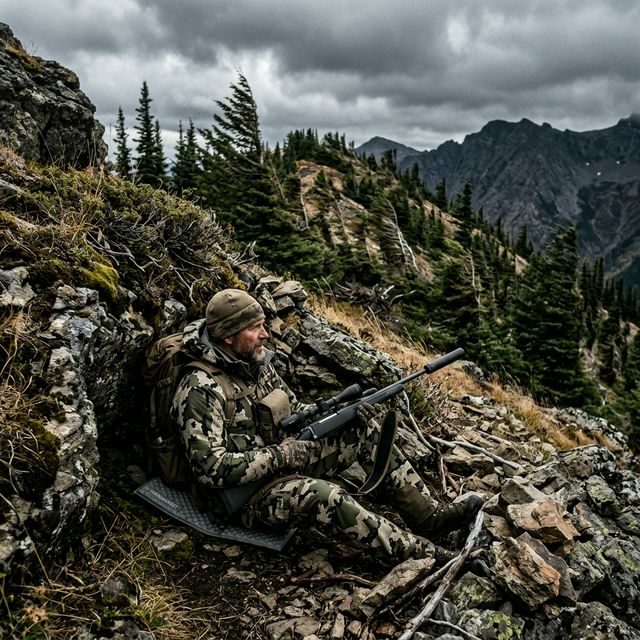
High-wind days are undeniably the absolute best time of the entire year to abandon your tree stand and execute an aggressive Spot-and-Stalk or Ground Still-Hunt.
- Massive Visual Camouflage: A whitetail’s eyes are highly attuned to movement. On a dead-calm day, a human raising a pair of binoculars immediately draws a deer’s attention. On a 25 MPH day, every single tree, bush, sapling, and blade of grass in the entire forest is in violent motion. This provides the ultimate, massive visual “noise” to completely cover your stalking movements.
- Acoustic Forgiveness: The roaring wind completely masks the sound of your boots snapping dry twigs or crunching through oak leaves, allowing you to walk with a speed and aggression that would be utterly impossible on a calm morning.
- Diluted Scent Cones: While heavy wind absolutely does not “kill” human odor, a highly velocity horizontal wind disperses and violently dilutes your scent cone so rapidly that it becomes much harder for a deer to pinpoint your exact geometric location.
CRITICAL SAFETY: The Widowmaker Risk
The romantic idea of toughing out extreme weather in a tree stand often ends in severe tragedy. When sustained wind speeds exceed 20 to 25 MPH, you absolutely must exit any elevated tree stand immediately.
- Strap Failure: The violent, continuous swaying motion of a 60-foot oak tree severely compromises the tension and structural integrity of ratchet straps, climbing sticks, and metal stand brackets.
- The Widowmakers: The most lethal threat in the woods during a storm is falling deadwood, universally known by loggers as “Widowmakers.” Massive, 500-pound dead oak and pine branches can snap without a millisecond of warning and fall silently from the canopy. They are instantly lethal. On severely windy days, keep your boots firmly on the dirt.
Do not be a fair-weather hunter hiding from the forecast. When the wind picks up and the woods become chaotic, understand the topographic shift. Find the quiet leeward pockets, stay mobile on the ground, and use the sensory blackout to your absolute tactical advantage.