
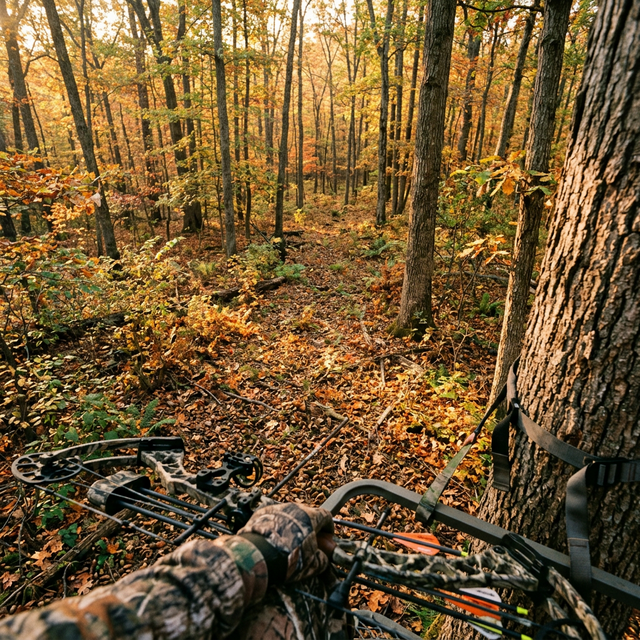
Hunting the October Lull: Cracking the Greatest Whitetail Myth
Do mature deer really just magically stop moving in mid-October? We aggressively break down the cellular data behind the famous 'October Lull' and reveal exactly how smart hunters can adjust their strategy to stay deadly.
Ask any casual deer hunter across the entire Midwest, and they will all emotionally complain about the exact same massive, frustrating phenomenon: The “October Dead Zone.”
Right around October 10th, your massive trail cameras suddenly go completely blank. The lush green soybean and alfalfa fields are completely empty of deer. The wide-open woods violently feel like a vacant, biological desert. For decades, hunters have blamed the “October Lull,” stubbornly believing that testosterone changes or hunting pressure magically made the deer simply stop moving for three straight weeks.
At Wildsnap, our team of biologists has meticulously analyzed thousands of hours of advanced GPS collar data, and we can definitively, scientifically tell you: The October Lull is a complete biological myth. The massive deer absolutely have not stopped moving; they have simply performed a massive, totally predictable Ecological Shift. If you don’t shift with them, your season is over.
1. The Science of the Shift: The Acorn Drop
Whitetails are the ultimate, biologically opportunistic survivors. They absolutely do not waste valuable calories. Between the highly specific dates of October 10th and October 20th across most of the eastern United States, a massive, sudden nutritional event violently occurs: The Hard Mast (Acorn) Drop.
- The Caloric Equation: Why on earth would a mature, desperately paranoid buck willingly walk 400 highly exposed yards in broad daylight to physically reach a mechanically harvested cornfield, when literally 1,000,000 highly dense, incredibly fatty calories of fresh acorns just violently fell out of the sky exactly 10 yards directly entirely from his hidden bed? He mathematically won’t. They have completely abandoned the dangerous agricultural fields because the woods themselves are now raining food.
- The Tannic-Acid Preference: You cannot just hunt any acorn tree. At Wildsnap, we focus our mid-October surgical strikes exclusively on White Oak ridges. White oak acorns possess significantly lower, far less bitter tannic-acid concentrations than the more abundant Red Oaks, making them infinitely sweeter and vastly more palatable to a deer. A massive, mature buck will intensely key in on a single, heavily dropping White Oak tree deep in the timber and rarely physically leave a tight 200-yard radius until that specific tree is entirely exhausted.
2. Defeating the “Dead” Trail Cameras
If your expensive trail cameras are still lazily pointed at a wide-open, tractor-cleared agricultural field edge on October 15th, you are officially hunting history. The deer have moved, and you are behind the curve.
- The Deep-Timber Dive: You absolutely must aggressively move your stands and surveillance inward to the deep internal transition zones. You must hunt the incredibly narrow oak ridges, the tight topographical saddles, and the thick draws that physically lead directly from the impenetrable bedding sanctuary to the hidden, shaded acorn flats.
- Zero-Intrusion Forensics: Because the massive summer canopy leaves are aggressively falling to the ground, the woods are opening up. You are vastly more visibly exposed than ever before. We heavily mandate using ultra-stealthy cellular trail cameras to strictly monitor these sensitive inner-timber hubs. Arrogantly marching into a buck’s deep-timber bedroom every three days simply to physically pull an SD card in mid-October is the absolute fastest, most efficient way to instantly turn a temporary “lull” into a “permanent exodus.”
FALL TRAUMA SAFETY: Foliage-Masked Obstacles and Gravity Hazards
Mid-October is statistically the absolute most physically dangerous time of the entire year for catastrophic foot travel and deep-timber navigation.
- The Hidden Traps: As millions of massive autumn leaves violently drop to the forest floor, they create a beautiful, thick visual “blanket” that completely heavily masks dangerous, leg-breaking dead-falls, deep hole-drifts, and jagged limestone rocks. We have routinely treated severe, season-ending ankle and tibia fractures from careless hunters violently stepping directly into hidden, rotten root-balls or massive groundhog holes completely obscured by the fresh leaves.
- The “Widow-Maker” Threat: Furthermore, you absolutely must be violently alert for “Widow-Makers”—massive, 500-pound dead oak branches heavily caught high up in the canopy that are finally violently loosened by the very first strong, aggressive fall cold-fronts. Always wear a hardened bump helmet while physically traveling or hanging tree stands in high winds, and meticulously watch the upper canopy carefully. The beautiful, romantic autumn forest is physically trying to drop a tree on you.
The agonizing October Lull is absolutely only a period of human hunter-stagnation. Fiercely follow the hard mast, aggressively hunt the massive dropping cold-fronts, and biologically realize that the giant buck of a lifetime is absolutely just 100 yards deeper in the nasty timber than you arrogantly think he is.