
Judging Distance in the Field: Calibrating Your Eye and Laser Rangefinder
Bowhunters live or die by yardage. Learn landmark ranging, mental maps, ARC angle math, and odd-yardage practice for when lasers fail in the timber.
For a rifle hunter on sticks at 100 yards, a 10-yard error rarely matters. For a bowhunter, a 5–10 yard misscall is the difference between both lungs and a clean miss—or a wounded deer. Arrows arc hard. Pins lie when ego guesses under adrenaline.
Laser rangefinders are excellent until batteries die, brush returns a false 18-yard reading on a 32-yard buck, or a deer trots through and you have no time to dig in a pocket. Analog distance skill remains mandatory. Build it alongside heavy arrow setups, smart stand placement, and ethical shot limits—including long-range rifle judgment when you switch weapons.
Why Bowhunters Feel Every Yard
A compound sighted with 20/30/40 pins has a steep gap between fibers. Misjudge 32 as 40 and you send the arrow high over the back. Misjudge 28 as 20 and you hit low in the legs. Add adrenaline, timber shadows, and a deer that looks “huge,” and untrained eyes stretch open ground while compressing brushy lanes.
Know three numbers before opening day:
- Your maximum ethical bow distance (where you group vitals cold under stress)
- Your confident gap zone (usually inside 30 yards for most woods hunters)
- Your no-shot rule when the number is uncertain
A 480-grain arrow at a known 28 yards beats a maybe-42 guess every time.
Organic Estimation: Landmark Methods That Work
The 20-yard bark test
In many Eastern hardwoods, about 20 yards (60 feet) is where oak bark texture stays sharp to the naked eye. If bark looks smooth and flat, you may already be past 25. Calibrate this on your own property with a rangefinder during practice sits—species and light change the cue.
Halfway rule
Pick an object near your max range. Mentally mark the halfway point. Humans judge 15 yards better than 40. If halfway is clearly 15, the object is 30. Use it under stress when the laser is buried under a rain cover.
Pace calibration
On the range, walk and memorize what 10, 20, and 30 paces look like in similar cover. Pace length shortens in briars and on slopes—recalibrate each September. Some hunters mark a quiet 20-yard reference stake near summer practice trees and glance at it until the image sticks.
Relative deer size (use carefully)
A mature buck’s chest depth can help at known photo distances, but stress warps this fast. Use body size only as a tie-breaker after landmarks—not as your primary system.
Open ag vs timber illusion
Cut corn and CRP make deer look closer than they are. Thick CRP and cedar edges make them look farther. When habitat changes mid-sit, re-trust landmarks over gut feel.
Pre-Ranging: Build a Mental Map Every Sit
Elite bowhunters rarely laser during the shot sequence. They laser before legal light.
- Clip into your harness safely.
- Range 8–12 landmarks in a full circle: rocks, stumps, crooked pines, trail junctions, creek edges, fence posts.
- Burn a mental card: “White rock 22. Crooked pine 35. Creek edge 44. Old snag 18.”
- Re-check after cutting new lanes or shifting the stand a few feet.
- Whisper the card once—hearing it helps memory more than silent reading.
When a buck stops at the white rock, you already know 22. No fumbling. No glass glint. No delay while he stares at movement.
For rifle hunters using holdovers or turret dials, the same habit speeds ethical decisions—see scope setup.
Angle Compensation and ARC / TBR Math
Gravity acts on horizontal distance. From a 25-foot stand or a steep ravine, line-of-sight (the hypotenuse) is longer than the horizontal distance that determines drop.
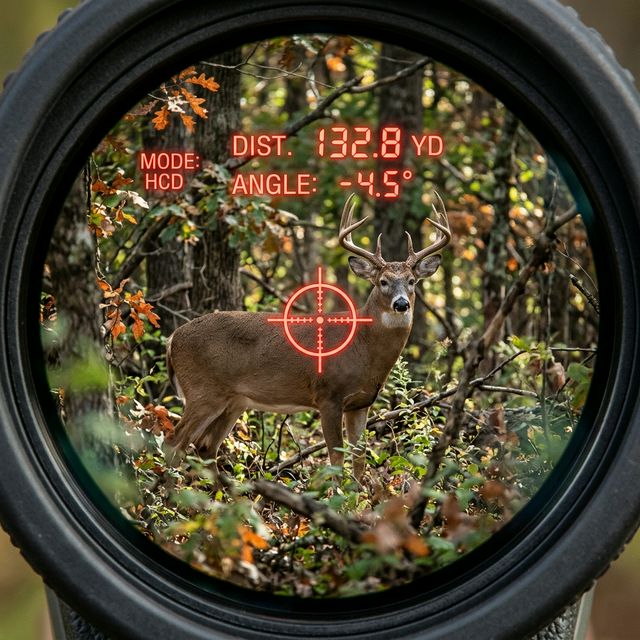
If line-of-sight says 35 and horizontal is closer to 30, aiming for 35 sends the arrow high. Angle-compensating rangefinders (ARC, TBR, or equivalent) run the trig and display the shoot-for distance.
Practical rules:
- High stands and steep shots: ARC mode on
- Flat ground sits: LOS can work if you understand the difference
- Verify mode before opening day—wrong mode is worse than no compensation
- Confirm whether your unit shows “shoot as” horizontal or another format; read the manual once
Even a 15-foot stand creates measurable error past 30 yards. ARC is cheap insurance.
When Rangefinders Lie
Common failure modes in real timber:
- Leaves and twigs return 18 yards when the deer is 32
- Rain, fog, and snow cut reliability and slow acquisitions
- Dark fur absorbs returns at odd angles
- Dead batteries on the best trail-camera buck of your life
- Gloved fingers fat-finger the wrong mode button
Fixes:
- Range the ground at the deer’s feet, not the body, when brush interferes
- Keep spare CR2/CR123 batteries in the kill pouch
- Always maintain the mental map backup
- Practice one-handed ranging from your exact stand posture
Practice That Transfers to the Woods
Stop practicing only on round numbers.
- Shoot 11, 17, 23, 27, 33, 37 on purpose
- Force pin gapping and hold judgment between fibers
- Practice from stand height, not only ground level
- Add a timed “buck walk” drill: pre-range landmarks, then shoot on a whistle without re-ranging
- Practice with your hunting gloves and jacket bulk
- Include a 5-yard chip shot—close misses happen when deer appear under the stand
Odd yardages are what real deer give you. Round numbers are a range luxury.
Field Routine on Every Sit
Use the same checklist until it is automatic:
- Safety harness first
- Quiet gear and release check
- Range landmarks; lock the mental map
- Confirm cut-lane distances after any trimming
- If a deer appears off-map, range the feet if time allows; otherwise use halfway/landmarks
- No shot without a number you trust
Uncertainty means hold. Another sit beats a bad track job and a sleepless night.
Slope, Fog, and Bad-Angle Shots
Terrain and weather distort yardage even when your laser works.
Uphill and downhill: A deer on a bench 15 feet below your stand can read farther on line-of-sight than the horizontal distance your arrow actually travels. Always favor horizontal shoot-for distance on angled shots. If you cannot confirm angle, shorten your max range by 5–10 yards from your flat-ground limit.
Sidehill shots: A deer quartering across a slope at what “looks like” 25 yards may be closer horizontally than your eye reads. Pre-range the slope face, not just flat landmarks at stand level.
Fog and drizzle: Lasers scatter in heavy moisture. Fall back to your mental map and the halfway rule. If visibility drops below 40 yards, treat every shot as a close-range decision only—no pin gapping in the gray.
Quartering-away geometry: A deer angled 45° away presents a longer path through the body than a broadside vitals window at the same horizontal distance. Range to the near-side shoulder, not the rump, when judging whether the shot is inside your ethical envelope.
Recovery link: A misjudged yardage often produces a marginal hit. Know your recovery plan and shot placement before you stretch distance on an uncertain number.
A Simple Opening-Week Calibration Drill
The week before opener, hang your stand or a practice tree and spend one evening doing nothing but ranging:
- Range 12 landmarks and write them on a card.
- Put the rangefinder away for 10 minutes.
- Guess each landmark from memory, then verify.
- Repeat until you are within 2 yards on every mark inside 40.
Do the same drill once in deep shade and once facing an open field edge. Those two backgrounds fool hunters differently. Forty minutes of calibration prevents a season of “I thought he was 30.”
Frequently Asked Questions
How accurate is a good laser on a deer’s body? Often ±1 yard in clear conditions. Brush and angle errors are the real problem—not the chip’s math. Feet-of-deer ranging fixes most false returns.
Should I wear a rangefinder on a chest harness? Yes for bowhunting. Seconds matter. Practice mounting and ranging one-handed from your stand posture until it is boring.
Do I need ARC for a 15-foot stand? Error is smaller than at 25–30 feet but still real at longer shots. Use ARC and learn what your unit displays.
Can I judge distance with binocular mil reticles? Possible with known-size targets and practice. Most whitetail bowhunters are better served by lasers plus landmark memory.
What if the buck is walking? Pass, or stop him with a soft mouth bleat only if you are already drawn or ready. Moving deer destroy yardage certainty—especially past 25 yards.
How often should I re-range landmarks? Every new sit, after any stand move, and after cutting lanes. Do not trust last week’s memory on a different tree.
Calibrate your eye, pre-range every sit, and never release until the number is honest. Yardage is the least forgiving variable in the archery woods.
Wildsnap • Open beta
Join Wildsnap and try the beta
In the open beta, you turn trail-cam data into actionable insights—free, fast, and simple.
No credit card