
Locating Fall Food Sources: Mastering Acorns, Crops, and Natural Browse
A highly aggressive, complete biological guide to finding critical whitetail natural food sources in the early fall. Learn exactly how to precisely identify highly preferred natural mast crops, specifically mastering the critical difference between white vs. red oak acorns.
When the massive summer heat finally breaks, the September thermometer sharply drops, and the daylight hours aggressively grow shorter, a highly mature whitetail’s entire biological survival suddenly strictly depends on one absolute thing: Massive Caloric Intake.
At Wildsnap, our tracking teams have spent decades forensically patterning mature bucks exactly as they rapidly shift their diet from disappearing green agricultural field edges directly into the deep hardwood timber. Absolute success in the early fall is not about guessing; it is heavily, surgically about proactively identifying the “Mast-Drop” and biologically understanding exactly which wild food sources are currently explosive and which are totally past their prime.
If you cannot identify a tree by its bark, you are effectively hunting blind.
1. White Oak vs. Red Oak: The Tannic Acid Factor
If there is absolutely only one heavily technical, botanical skill you completely master this entire hunting season, let it be the explicit identification of the oak tree family. All acorns are biologically absolutely not created equal.
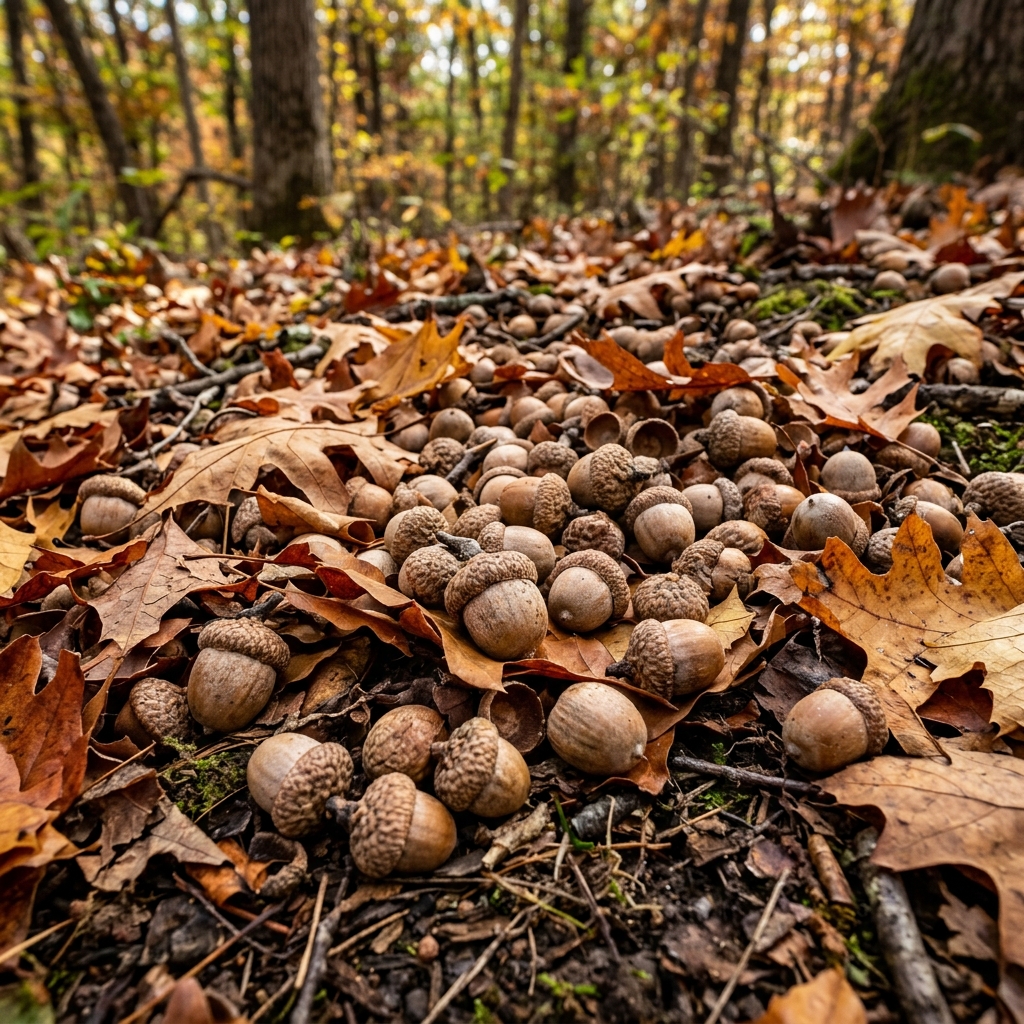
- The White Oak Gold Mine: White oak acorns are the absolute “candy” and sweet treat of the entire autumn woods. They biologically possess significantly lower levels of bitter tannic acid, making them immediately, wildly palatable to a deer the exact second they hit the ground. A mature buck will happily walk completely through a mile of generic, foodless woods simply to find a single, massively producing white oak.
- The White Oak Identification: You must aggressively look for rounded, deeply lobed leaves (no sharp points) and light, highly flaky, ash-colored gray bark that almost looks like it is peeling off the tree in long strips.
- The Red Oak Backup Plan: Red oak acorns are incredibly bitter and massively high in tannic acid. Deer will typically entirely ignore a massive red oak flat until the sweeter white oaks are completely gone, or until the red acorns have been heavily “weathered” by weeks of winter rain and snow washing the acid out. Red oaks have deeply pointed, incredibly sharp-tipped leaves and very dark, tightly furrowed, hard “ski-trail” bark.
2. Identifying the “Money Tree”
You absolutely cannot just lazily walk into the woods and arbitrarily hunt “a big oak flat.” That is a massive waste of time. At Wildsnap, we aggressively look for the single, solitary Money Tree.
- Fresh Ground-Level Forensics: You must aggressively walk the ridge with your eyes glued to the dirt. Look heavily for the “crime scene”—thousands of wildly turned-over brown leaves, massive amounts of fresh, soft green droppings (clumped scat vs. round winter pellets), and thousands of freshly cracked, half-eaten acorn caps violently scattered around the base of one specific, giant white oak. That is the Money Tree. Hang your stand exactly 20 yards downwind of it.
- Soft Mast Highs (The Dessert): Absolutely never overlook the explosive, highly isolated pockets of wild Persimmons, Wild Crabapples, and Honey Locust pods. These are massive, high-sugar “biological desserts” that dramatically drop in early October and can strongly, powerfully pull a massive buck completely off his normally strict, structured travel pattern like a giant magnet.
DEEP TIMBER SAFETY: Remote Navigation Hazards
Aggressively searching for completely hidden, deep-woods white oak flats naturally frequently violently pulls hunters for miles far away from massive, established logging trails and comfortable farm roads.
- The Battery Death: You must absolutely never rely solely on a standard smartphone GPS app to navigate your way completely out of a 5,000-acre tract of public timber. Brutally freezing early morning temperatures can violently, unexpectedly kill a perfectly healthy lithium-ion phone battery from 80% to dead zero in literally a matter of minutes.
- The Manual Backup: You absolutely must always aggressively carry a physical, magnetic high-quality Baseplate Compass, a heavily detailed paper topographical map of the area, and a massive, fully charged backup battery power bank sealed in a waterproof bag.
- The Predator Overlap: Additionally, be hyper-aware of your immediate physical surroundings; massive, highly productive hard-mast acorn flats are also the absolute primary, high-density autumn food sources for incredibly aggressive, hungry Black Bears and massive, territorial Feral Hogs actively preparing for winter. Keep your head on a swivel.
Extreme botanical precision in the dense timber absolutely directly leads to lethal precision in the final shot. Deeply know your individual trees, accurately identify the exact timeline of the mast drop, and you will definitively find exactly where the massive deer are successfully feeding today, rather than hunting empty woods where they were safely feeding yesterday.