
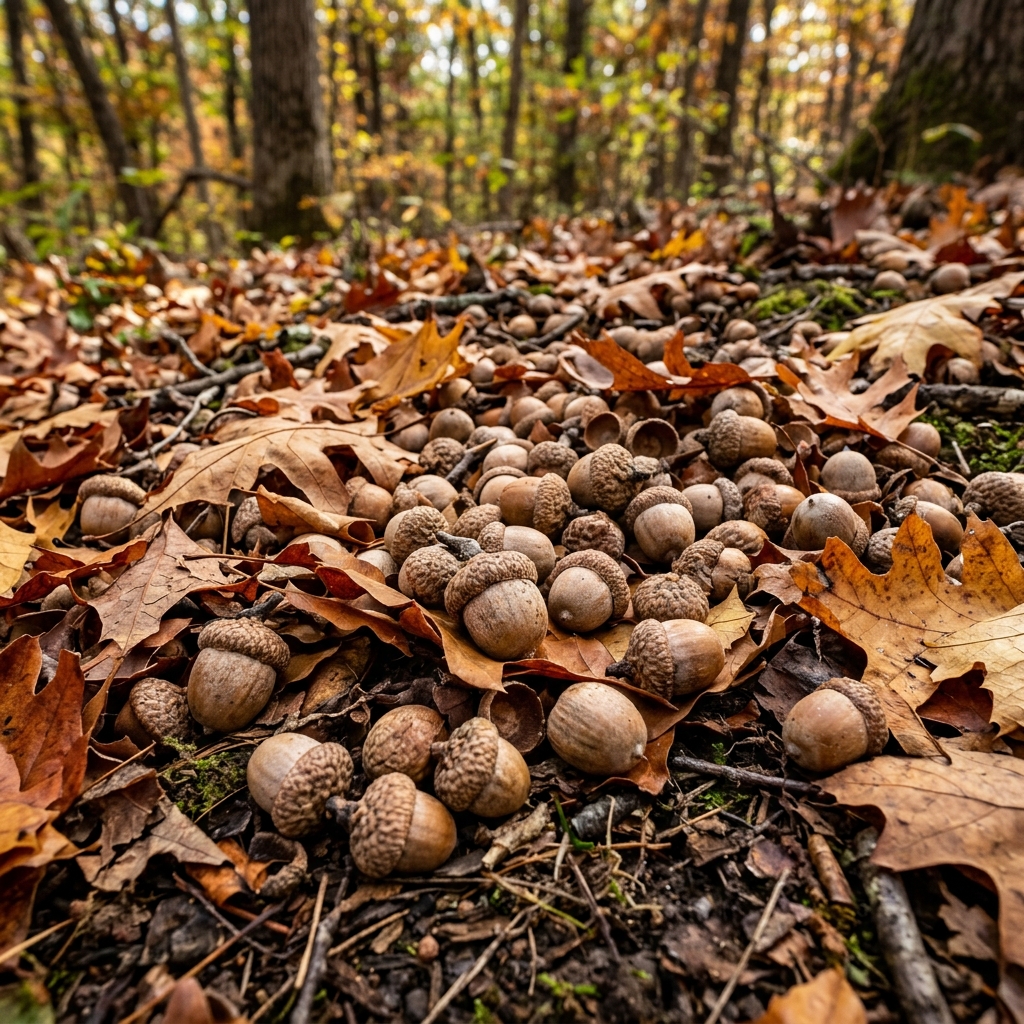
Locating Fall Food Sources: Mastering Acorns, Crops, and Natural Browse
Find early-fall whitetail food by IDing white vs red oaks, money trees, soft mast, and crop edges. Scout sign on the dirt—not just big timber on a map.
When September cools and days shorten, mature whitetails shift hard toward calories. Summer greens fade; mast and grain take over. Early-fall success is less about lucky sits and more about knowing which food is hot this week—and which tree is actually getting hit.
If you cannot tell oak species by bark and leaf, you will hunt yesterday’s groceries.
White Oak vs Red Oak: Tannins Decide
Not all acorns are equal.
White oaks
- Lower tannic acid—sweeter, eaten immediately on drop
- Rounded leaf lobes without bristle tips
- Lighter, flaky gray bark strips
Red oaks
- Higher tannins—bitter until weathered by time and moisture
- Pointed, bristle-tipped lobes
- Darker, tighter “ski-trail” bark furrows
A buck will walk past red oak flats to reach a single heavy white oak. When white oaks empty, reds and leftover crops rise in rank. That hand-off is a big part of what people call the October lull.
Find the Money Tree, Not “an Oak Flat”
Hunting a generic ridge of oaks wastes time. Find the individual producer with fresh forensic sign:
- Leaves flipped in a tight radius
- Cracked caps and half-eaten kernels
- Soft clumped scat (not only winter pellets)
- Multiple trail convergences at one trunk
Hang roughly 15–25 yards downwind of that drip line. Recheck every few days—squirrels and deer can finish a tree fast, then shift 80 yards to the next.
Soft Mast: Short, Violent Magnets
Persimmons, crabapples, pears, and honey locust pods pull deer off predictable ag patterns for brief windows. They are sugar spikes, not season-long staples.
Scout abandoned orchards, fence rows, and creek edges. Hunt them while pulp is wet and fresh, then abandon them without nostalgia. Full tactics: how to hunt persimmons and soft mast.
Crops and Field Edges Still Matter—Sometimes
Beans, alfalfa, and corn remain magnets when:
- Mast failure hits your timber
- Early season patterns still hold before major drop
- Night feeding in fields pairs with daylight staging just inside timber
Do not sit the open edge by default. Stage 50–80 yards inside on trails that feed the field—same logic as early season whitetail tactics and how to hunt standing corn fringes.
Browse and Transition Foods
When mast is spotty, watch:
- Greenbrier, honeysuckle, and other green browse in ditches
- Soft mast leftovers under frost
- Food plots and micro-plots holding clover or brassicas—see poor man food plots
Deer are opportunistic. Your job is to rank foods by current preference, not by what worked last October.
A Weekly Food Audit System
Build a simple rotation:
- Monday–Tuesday: walk two ridges; mark trees with fresh caps
- Midweek: check cameras on field edges vs timber hubs
- Pre-hunt: confirm wind for the hottest pin only
- Post-front: re-walk—cold snaps change drop rates overnight
Log dates and tree IDs in your map app. Patterns emerge across seasons.
Safety While Roaming Timber
Deep mast hunts pull you off roads.
- Carry compass/paper map; cold kills phone batteries
- Watch for bears and hogs on the same mast
- Tell someone your loop and ETA
- Wear blaze when firearm seasons overlap
Navigation redundancy matches advice in e-scouting whitetails.
From Food Source to Ambush
Food is only half the set. Tie it to bedding with a trail that offers a crosswind:
- Morning: often timber food to bed (hunt carefully)
- Evening: bed to food (classic high-odds)
- Rut: bucks scent-check food edges for does even when not feeding hard
Bedding context: understanding whitetail bedding areas.
Ranking Foods Week by Week
Build a simple preference ladder and update it every scouting loop:
- Fresh white oak drop with active feeding sign
- Ripe soft mast with wet pulp
- Unharvested beans/alfalfa with daylight staging
- Red oak after whites taper or fail
- Browse and leftover plots
When two foods tie, hunt the one closer to bedding with a wind you can trust. Calories mean nothing if you cannot sit them cleanly. Keep a note on your map pin: “white #3 finished 10/14—moved to red flat east.” Future-you will thank present-you during the November shuffle.
Crop Rotation and Farmer Relationships
Talk to landowners. Ask harvest dates for corn and beans. A field that looks perfect on Saturday satellite may be empty Monday after the combine. Offer help with gate etiquette and parking, and you often get the text when standing corn is coming down—intel that beats guessing from the road.
On public land, watch parking patterns after harvest: empty ag edges push everyone into timber the same weekend. Arrive with two oak pins ready so you are not improvising under pressure.
Sign Aging: Fresh vs Yesterday
Hunters waste sits on cold sign. Learn to age feeding evidence:
- Wet, light-colored acorn meat and shiny caps = recent
- Dark, dried kernels and dusty caps = older
- Soft, shiny scat vs dry, dusty pellets
- Leaves flipped showing dark moist soil vs already re-settled litter
Walk slowly with your eyes on a 10-foot circle. The money tree announces itself with chaos in a tight radius. If the whole ridge looks casually picked, deer are browsing in passing, not locking down.
Return 48 hours after a windstorm. Fresh drop changes the map overnight. The tree that was dead Tuesday can be nuclear Thursday. Flexibility is a hunting skill equal to shooting form.
Carry a small notebook or map note: date, tree ID, sign grade (A/B/C), wind for a possible sit. After a month you will see patterns your memory alone will smear together.
Regional Mast Quirks Worth Knowing
Northern hardwoods may drop earlier and harder than southern mixed forests. Drought years shift preference toward irrigated ag and moist bottom mast. Bumper red oak years can still lose to sparse white oaks because tannins matter more than volume.
Floodplain hunters should watch soft mast and white oaks on first benches above high water. Ridge hunters should treat saddles near oak flats as dual-purpose food-and-travel sets. Suburban fringe hunters may find backyard fruit and ornamental oaks pulling deer in ways classic timber maps ignore—hunt legal boundaries carefully.
Keep regional biology books or agency mast reports bookmarked. Local knowledge beats national blog generalizations every time. Your dirt’s timeline is the only one that fills tags.
Building a Property Food Calendar
Create a one-page calendar for each property you hunt:
- Soft mast peak window
- White oak drop start/peak/end
- Red oak relevance start
- Crop harvest dates
- Brassica sweetening after frost
Update it every scouting trip with real dates, not guesses. After two seasons you will stop hunting empty ridges in mid-October because the calendar told you whites finished four days ago. Share the calendar with hunting partners so the whole group shifts together instead of burning last week’s oak.
Pair the calendar with two stand trees per major food phase—one for each primary wind—so you are never forced into a bad sit just because the food moved.
The hunters who fill early-fall tags are the ones who re-walk ridges after every wind event and honestly retire trees that went cold. Mast is a moving target; your stands should move with it, not with last year’s memory.
Walk slowly, grade sign honestly, and retire cold trees without ego. Fresh caps and soft scat beat nostalgia every single week of autumn. Keep notes, trust the dirt, and let this week’s mast—not last year’s story—choose your tree.
Frequently Asked Questions
How do I ID white oak without leaves?
Bark and acorn shape help: white oak bark is blockier/flakier; acorns are typically longer with bowl-like caps. Practice in summer when leaves confirm ID.
Why are cameras blank on the bean field in mid-October?
Deer likely shifted to mast. Move cameras and stands to white oak hubs before you blame a mythical “lockdown.”
Should I hunt red oaks in September?
Usually low odds if white oaks are dropping. Reds shine later after leaching or when whites fail.
How close should I scout to opening day?
Glass and edge-check late, but keep deep intrusion minimal within 7–10 days of hunting a sanctuary tree.
Do mineral sites replace mast scouting?
No. Minerals are supplemental. Fall kill maps still start with calories on the ground. See establishing deer mineral sites.
Botanical precision leads to shot precision. Identify the mast timeline, hunt the money tree while it is hot, and move when the dirt goes quiet.
Wildsnap • Open beta
Join Wildsnap and try the beta
In the open beta, you turn trail-cam data into actionable insights—free, fast, and simple.
No credit card