
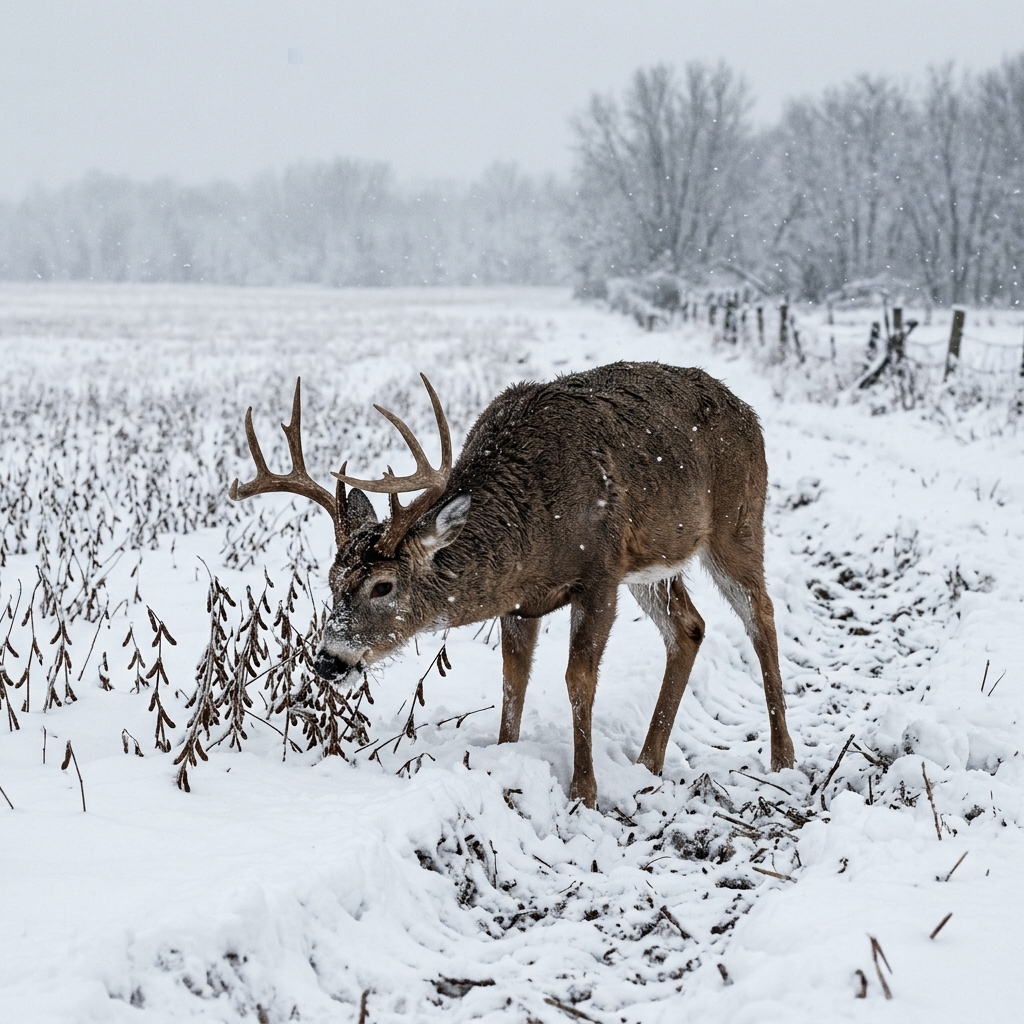
Post-Rut Recovery: Hunting Late Season Food Sources like a Professional
When the brutal temperature finally plummets and the deep snow flies, the entire hunt becomes strictly about calories. Learn exactly how to tactically find the absolute best winter food sources and how to hunt exhausted Post-Rut bucks.
By the time the brutal cold of late December or early January physically arrives, the high-octane, chaotic energy of the November rut is a completely distant memory.
Massive, mature bucks are entirely exhausted, often having rapidly lost 20% to 30% of their total body weight due to a month of non-stop chasing and fighting. In the brutal late season, a whitetail’s biology violently shifts entirely into a single, unified gear: Absolute Survival.
At Wildsnap, our winter field data proves that the guaranteed late-season hunting strategy isn’t about the rut at all anymore; it is entirely, mathematically about the Calorie-to-Effort Ratio. Massive bucks desperately need huge amounts of carbohydrates and fats to physically stoke their internal furnace to stay warm in sub-zero temperatures, and they biologically need them as physically close to their warm bedding areas as possible.
1. What Exactly Do Deer Eat After the Rut?
The lush, wet, highly nutritious green leaves of the easy summer are entirely dead and gone. Deer now deeply rely on “standing” agricultural food or hard mast that physically provides a massive, high glycemic index to rapidly generate core body heat.
- Brassicas (The Sugar Shift): Deeply planted food plots containing turnips and radishes undergo a massive biological change after a hard, killing frost. The freezing temperatures violently convert the bitter starches in the giant leaves and tubers directly into highly sweet, simple sugars. At Wildsnap, we refer to this as the “Ice Cream Phase.” Starving deer will literally happily dig through 12 inches of frozen snow to frantically reach the incredibly sweet, frozen radishes.
- Standing Soybeans and Corn: If you are incredibly lucky enough to have access to a massive standing bean field or un-harvested corn that was explicitly left by the farmer, you mathematically control the absolute center of the local winter ecosystem. The incredibly high fat, carbohydrate, and protein content explicitly locked in the dried beans are biologically essential for a buck’s winter survival.
- Woody Browse (The Big Woods Lifeline): In massive, unbroken timber properties where zero agriculture exists, starving deer entirely rely on the “tips” of woody browse (specifically red maple, white cedar, and red osier dogwood). We have heavily verified that strategic hinge-cut logging areas provide literal thousands of pounds of high-quality, life-saving canopy browse safely lowered directly to a deer’s mouth level.
2. Hunting the Thermal Bedding Transition Line
Because extreme conservation of caloric energy is the absolute only biological objective left, late-season whitetail deer move incredibly predictably. They desperately want to travel the shortest possible physical distance directly between their incredibly warm thermal bedding (like a dense, wind-blocking cedar thicket) and the massive food source.
- The Afternoon Window: You must completely forget the freezing morning hunts. In the brutal late season, blindly hiking into the dark woods at 5:00 AM will almost certainly violently spook every single deer that has been safely feeding in the destination field all night long.
- The Golden Hour: You must exclusively focus your entire aggressive strategy on the absolute final two hours of fading daylight in the late afternoon. As the sinking sun rapidly drops behind the trees and the ambient temperature suddenly plummets, the biological dinner bell rings. The most mature bucks will finally stand up from their warm beds and slowly walk the exact same packed-snow trail to the food every single evening. You just need to be sitting in a blind mathematically intercepting that literal path.
WINTER BLIND SAFETY: The Silent Threat of Carbon Monoxide
Brutally cold late-season hunts almost absolutely require the physical use of enclosed pop-up ground blinds or hard-sided box blinds to simply hold back the freezing, biting wind.
- The Heater Trap: If you choose to use a portable, indoor-safe propane heater inside an aggressively zipped-up, air-tight hunting blind, you absolutely MUST forcibly ensure proper, constant air ventilation.
- The Lethal Fumes: A running propane heater in a tiny, totally sealed tent violently consumes oxygen and rapidly replaces it with completely odorless, deeply lethal Carbon Monoxide (CO) gas. Never fall asleep in a heated blind, and absolutely always keep at least one upper window significantly cracked open to allow heavy, continuous fresh air flow through the tent.
The freezing late season is the absolute ultimate test of a dedicated hunter’s psychological and physical endurance. Dress heavily in massive layers, surgically find the massive carbs, and obsessively watch the incoming weather fronts. When the mercury violently drops into the single digits, the biggest bucks in the woods are biologically forced to step into the daylight to survive.