
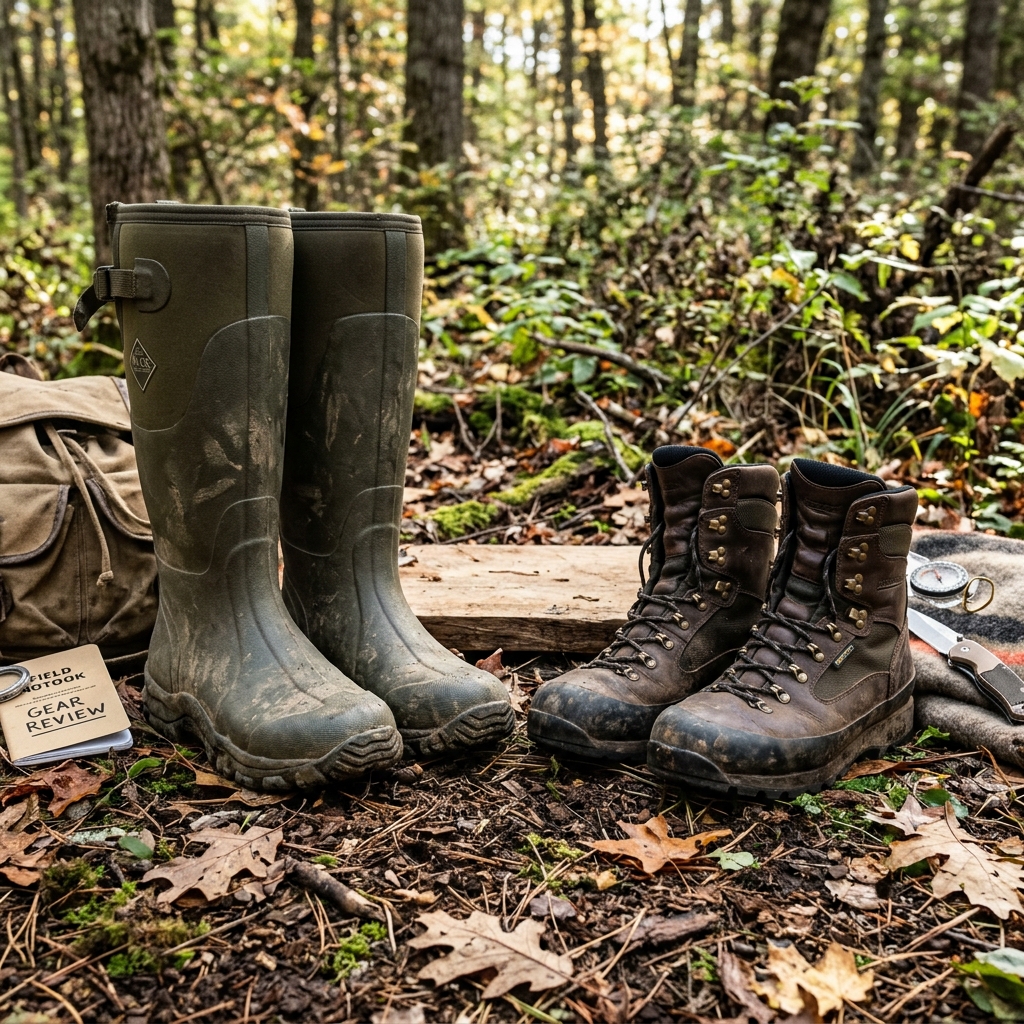
Rubber vs. Leather Hunting Boots: Choosing the Ultimate Tactical Footwear
Rubber vs. leather hunting boots compared: scent control, ankle support, insulation grams, fit tips, and when each footwear style wins for whitetails.
The right hunting boots can make or break a week afield. In whitetail country the rubber-vs-leather debate usually reduces to one question: do you need maximum ground-scent control, or hiking performance and ankle support?
There is no universal winner—only the best match for terrain, temperature, and sit style.
Rubber Boots: Scent Control and Wet Ground
Knee-high rubber boots (Muck, LaCrosse, and similar) remain the archery-whitetail default for one reason: non-porous scent containment.
Pros
- Vulcanized rubber does not breathe, so foot odor stays inside the boot
- Fully waterproof for creek crossings and flooded timber
- Easy to rinse mud and foreign odors off the exterior
- Quiet on damp leaves compared with hard lug soles when wet
Cons
- Zero breathability → sweaty feet that chill when you sit
- Poor lateral ankle support on steep, uneven hills
- Heavier and clumsier for long approaches
- Can freeze stiff in extreme cold if undersized or soaked inside
Best use cases: short walks (under ~0.5 mile) to swamp, CRP, and flat timber stands where scent and water matter more than mileage.
Scent discipline still requires clean pants cuffs and controlled exits—boots alone will not fix a bad wind. See whitetail scent control.
Leather and Mountain Boots: Miles and Support
Laced leather or synthetic mountaineering boots (Kenetrek, Crispi, and peers) surged among mobile public-land hunters.
Pros
- Rigid lateral ankle support on rocky, steep approaches
- Lighter feel over 2–5 mile hikes
- Breathable membranes (e.g., Gore-Tex) move sweat out while blocking water
- Better braking and edge control on sidehills
Cons
- Porous leather and laces absorb truck, camp, and garage odors
- Harder to keep truly scent-neutral without sprays, airing, and storage discipline
- Membranes fail if neglected or paired with soaked socks all day
- Louder on crusty leaves unless you slow down
Best use cases: saddle hunts, mountain public land, and any day where the approach is the hard part.
Insulation: Match Grams to Your Hunt Style
Thinsulate (or equivalent) ratings should follow activity, not ego.
| Hunt style | Typical conditions | Insulation guide |
|---|---|---|
| Mobile early season | 40–60°F, hiking | Uninsulated |
| Mid-season / rut sits | Frosty mornings, all-day | 400–800g |
| Late season stand hunting | Near 0°F, motionless | 1,200g+ or oversized rubber + heavy merino |
Over-insulation on a fast hike creates sweat, then freeze. Under-insulation on a December sit ends the hunt at 9:00 AM.
Late-season comfort also depends on the rest of your clothing system—see cold weather layering.
Fit, Socks, and Blood Flow
Frozen feet are often a fit problem, not a brand problem.
Rules that matter:
- Leave room to wiggle toes in the sock system you will hunt in
- Do not cinch laces so tight that you cut capillary flow
- Use a thin liner sock under a medium merino hunting sock
- Change into dry socks at the stand if the walk-in soaked them
- Size rubber boots with the sock stack in mind—many hunters go a half size up
Chemical toe warmers help in extreme cold when stuck on the outside of the sock over the toes, not trapping moisture against bare skin.
Terrain Decision Matrix
Use this quick chooser:
- Creek bottoms, swamps, short walks, scent-critical archery: rubber
- Steep public ridges, long mobile days, rocky ground: leather/mountain
- Mixed season: own both; pick nightly based on forecast and stand distance
- Deep snow stands: insulated rubber or pac boots with removable liners
If you hunt small, fragile parcels where every scent molecule matters, rubber plus perimeter entry pairs well with small woodlot strategies.
Care and Longevity
Rubber care:
- Rinse mud; dry upright out of direct blast heat
- Inspect for cracks at the ankle flex point
- Store cool; UV and furnace rooms shorten life
Leather care:
- Clean, dry slowly, then condition leather as the maker recommends
- Re-proof membranes periodically
- Store with cedar or open air—not sealed damp in a truck
Replace boots when midsoles collapse or waterproofing fails mid-creek in November—not during the drive to opening morning.
Hybrid Approaches Hunters Actually Use
Many serious hunters run systems, not one pair:
- Rubber for evening food-plot sits 200 yards from the truck
- Leather for dawn public-land saddles two miles in
- Oversized rubber slipped on over dry socks after a leather hike to a stand (cache the leather nearby if practical)
The hybrid hike-then-swap method adds weight and logistics but solves sweat-then-freeze on long approaches to wet stands.
Break-In and Pre-Season Testing
Do not debut stiff leather boots on a three-mile November hike. Break them in during late summer scouting with the same sock system you will hunt in.
Test checklist:
- Walk at least 3–5 miles on mixed terrain before season
- Stand motionless for 30 minutes to feel cold spots and heel slip
- Confirm waterproofing after a hose test or creek crossing
- Recheck lace hook sharpness that can cut glove liners
Rubber boots need less break-in but still deserve a creek rehearsal so you know true traction on algae-covered rocks. Mark a dedicated “hunt only” pair and keep truck boots separate to reduce foreign odors in leather.
Quietness and Sole Choice
Sole compound changes how loud you are on crust and dry oak leaves. Soft gum-rubber bottoms on many rubber boots hush well when damp but can feel slick on steep frost. Aggressive Vibram lugs on mountain boots grip rock and ice better but telegraph every step on brittle leaves unless you slow down.
Practical compromise:
- Slow your cadence in leather on dry mornings—speed is optional, stealth is not
- Prefer damp or frosted mornings for noisy approaches when you must use aggressive lugs
- Clear mud from lugs before climbing sticks so you do not clatter steel
Boots are only one noise source; pack straps and pant shells often outrank soles. Still, choosing the quieter tool for short scent-critical walks is free performance.
Budget vs. Premium: Where Money Matters
Spend on fit and waterproof integrity before carbon-fiber shanks and brand mythology.
Worth paying for:
- A last that matches your foot shape
- Replaceable or resolable construction on leather you will keep 5+ years
- Proven membrane reliability if you hunt wet climates
Safe to save on:
- Marketing insulation claims without matching your sit style
- Extra “scent control” coatings that wash off
- Duplicate colors of the same boot
If your budget allows only one pair, pick based on your most common hunt—not the fantasy mountain trip you take once a year. Add the second style later.
Weather Transitions and Mid-Season Swaps
October mornings can start at 28°F and hit 55°F by the walk-out. Boots that were perfect at dawn become sweat boxes by 10:00 AM.
Tactics for swing days:
- Start with lighter insulation and add chemical warmth only if toes fade
- Carry a dry sock pair in a zip bag for after the hike
- Prefer breathable leather on mobile warm fronts; switch to rubber when rain moves in overnight
- Accept that “one boot for every forecast” is a myth—check the hourly graph before you leave the house
Late December removes the debate for many stand hunters: maximum insulation and blood-flow-friendly fit win. Early October public-land saddles reverse it again toward support and breathability. Build a two-pair shelf and you will stop forcing the wrong tool into the wrong day. For how footwear ties into full-body systems on zero-degree sits, revisit cold weather layering.
Frequently Asked Questions
Do rubber boots really stop scent? They greatly reduce foot-scent transfer to the ground compared with porous boots. They do not erase pants, breath, or wind mistakes.
Can I hike miles in rubber boots? You can, but ankle fatigue and sweat make leather smarter past roughly a mile of rough ground for most people.
How much insulation for November? For motionless sits in typical Midwest frost, 400–800g is the common sweet spot.
Are pac boots better than rubber in extreme cold? Removable-liner pac boots often win for all-day zero-degree sits; rubber wins for water and quick rinsing.
Should I buy expensive boots or mid-tier? Fit and insulation matching beat logos. Try them on with hunting socks before you spend.
The best hunting boot is the one matched to your terrain and temperature. Long mountain miles favor leather; short, wet, scent-critical sits favor rubber.