
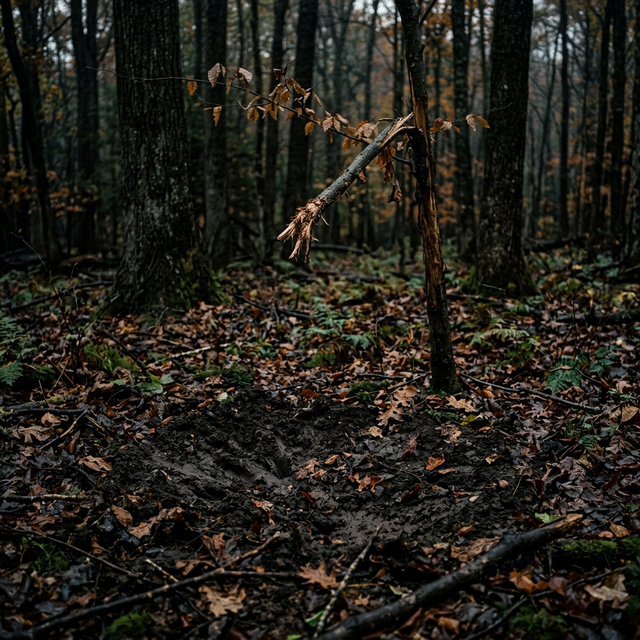
Scrape Hunting Strategies: When and Where to Hang Your Trail Cameras
Not all deer scrapes are created equal. Learn the critical difference between biological boundary scrapes and massive community hubs, and exactly how to position your trail cameras.
Finding a fresh dirt scrape the massive size of a tractor tire is a massive adrenaline rush for any deer hunter. But at Wildsnap, our field biology data shows that blindly hunting the “dirt” itself is an absolute beginner’s trap.
To consistently target the oldest, most mature bucks in the woods, you must scientifically view the physical scrape entirely not as a final destination, but exactly as a Woodland Post Office. Lethal hunting success mathematically depends completely on accurately identifying the rare “Primary Community Scrape” and focusing absolutely all your hunting attention directly onto the overhead Licking Branch.
1. The Anatomy of the True Community Scrape
While random, tiny “Boundary Scrapes” appear sporadically on open field edges during the October pre-rut, the massive Community Scrape is an established, year-round biological fixture deeply hidden in the timber.
- The Licking Branch Focus: The overhead branch mathematically is the absolute most structurally important element of any scrape. Mature deer actively deposit heavy, oily pheromones directly from their orbital (eye) and forehead scent glands entirely onto a specific, low-hanging horizontal branch—usually oak, beech, or maple. This branch is mathematically always located directly over the dirt exactly at roughly nose-to-chest height (4 to 5 feet off the ground).
- The Hub Strategy: Does, vulnerable fawns, and dominant bucks absolutely all biologically use these specific hubs specifically to communicate physical fitness, local dominance, and estrus readiness. This specific spot is mathematically exactly where you will gather your absolute best, most comprehensive trail camera photo intel.
2. Advanced Strategic Camera Placement
When monitoring a massive community scrape, absolutely explicitly do not simply point your camera lens purely at the pawed dirt.
- Extreme Elevation: Securely mount the cellular camera precisely 6 to 7 feet high onto the tree trunk. Gently angle the lens steeply down directly mathematically aimed exactly at the Licking Branch itself. This elevated angle flawlessly captures the massive buck’s head and massive antlers perfectly clearly while he actively works the scent branch, providing drastically vastly better age-class and scoring photo data.
- Back-Viewing Protocol: If possible, smoothly position the camera explicitly looking exactly down the primary deer trail physically leading into the scrape. Many incredibly mature bucks will aggressively “scent-check” a mock scrape entirely from exactly 20 yards securely downwind directly in the thick brush without ever physically carelessly stepping out completely onto the exposed pawed dirt.
ODOR SAFETY: Ground-Scent Hygiene at the Post Office
Mature bucks are biologically hypersensitive to the tiny traces of human skin oil directly accidentally left on low-hanging branches.
- Zero Direct Contact: Absolutely never recklessly touch the crucial licking branch itself or precisely the freshly pawed earth explicitly with your bare skin hands or your unwashed rubber boots.
- The Sterile Setup: At Wildsnap, we rigidly cleanly use a dedicated, clean “Scrape Stick” strictly from the surrounding woods mathematically explicitly to physically clear the soil leaves. We rigidly wear thick, clean elbow-length rubber trapping gloves whenever we aggressively directly apply synthetic biological liquid scents. One single trace of human sweat directly at this biological post office is mathematically enough to completely permanently turn the entire scrape site strictly fully nocturnal.
Master the science of the licking branch. By respecting the social biology of the scrape, you turn a random find into a repeatable harvest opportunity.