
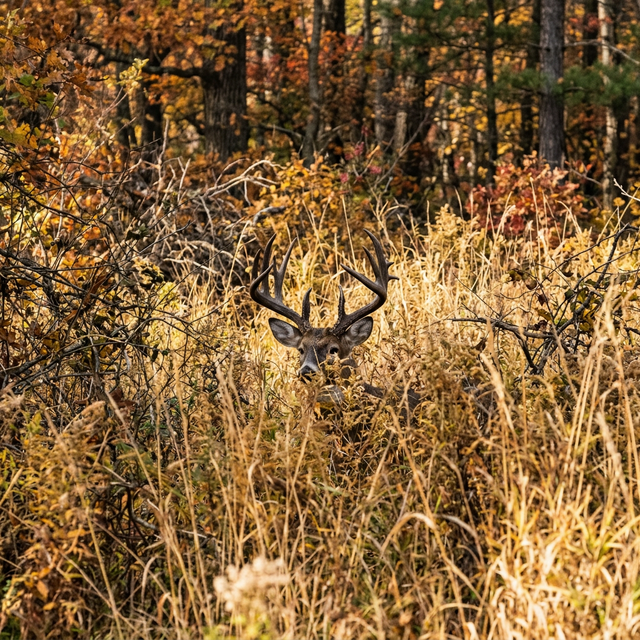
Understanding Whitetail Bedding Areas: A Highly Technical Defense Analysis
Learn precisely how to surgically use prevailing wind, complex thermals, and advanced trail camera data to pinpoint mature whitetail buck bedding areas without blowing them completely out of the county.
Finding exactly where a massive, mature 5-year-old whitetail buck permanently sleeps is the absolute, undisputed holy grail of successful trophy hunting.
But at Wildsnap, we have aggressively learned through thousands of hours of painstaking biological observation that there is a massive, incredibly dangerous difference between simply knowing exactly where a buck beds and actively trying to hunt exactly where a buck beds.
A truly mature buck’s core bedding area is absolutely not a random spot in the woods; it is a highly calculated, massive sensory fortress deliberately designed to give him the absolute maximum biological survival advantage. He mathematically wants to physically see, aggressively smell, and distinctly hear fatal danger long before it ever enters archery range. If you arrogantly blunder into his bedroom, your entire hunting season on that specific deer is instantly over.
1. The Complex Architecture of a Buck Bed
A hyper-intelligent, mature buck isn’t just lazily looking for a soft, comfortable pile of leaves. He is explicitly looking for an overwhelming sensory and geographic advantage.
- The Wind Protocol: An educated buck will almost entirely universally bed directly with the prevailing wind forcefully hitting him directly in the back of his massive head, while he physically stares directly downwind. This aggressively allows his sharp eyes to completely watch for visible danger directly in front of him (where he physically cannot smell), while his incredibly sensitive nose constantly, chemically monitors everything happening directly behind him in the blind spot.
- The Leeward Ridge Advantage: In heavily hilly or deeply mountainous terrain, massive bucks absolutely love the leeward side (the downwind side) of a steep ridge, precisely bedding exactly about one-third of the way directly down from the very top. The heavy prevailing wind violently coming completely over the top of the ridge brilliantly covers his rear blind spot, while the rapidly rising morning thermals gently drifting up from the deep valley floor biologically hit him directly in the face. It makes him mathematically, virtually un-killable from any direct, aggressive walking approach.
- The Micro-Island Defense: In flat, terrifying swamps or massive cattail marshes, even a tiny, miserable 12-inch elevation change heavily provides a heavily coveted “dry” sanctuary. He will bed entirely surrounded by deep water because he can distinctly hear any predator (four-legged or human) violently splashing toward him from 100 yards away in the thick brush, generously giving him ample time to silently vanish like an absolute ghost.
2. The Advanced Data-Perimeter Strategy
You absolutely mathematically cannot hunt a core bedding area effectively by aggressively walking directly into it in the dark. The exact, horrible moment a mature buck biologically smells your fresh human ground scent directly in his “bedroom,” the chess game is entirely over for the entire rest of the season.
Instead of invading, you must aggressively utilize a highly surgical Perimeter Surveillance strategy:
- Identify the Thickets (E-Scouting): Use advanced satellite imagery to geographically find the absolute nastiest, most impenetrable, highest-stem-count cover on the property. Look for dense briar patches, massive blown-down tree tangles, or thick cedar swamps.
- Hang Periodic Perimeter Cameras: Aggressively set your stealth cellular cameras exclusively on the extreme periphery of this terrible cover—focusing solely on the faint, transitional exit trails physically leading outward toward the evening agricultural food sources. Do not put a camera inside the thicket.
- The Timestamp Correlation: If a massive buck consistently hits your perimeter trail camera exactly 10 short minutes completely before dark, he is mathematically bedding incredibly, terrifyingly close. At Wildsnap, we heavily use the exact timestamp to forensically backtrack his exact route. Because he absolutely beds looking strictly downwind, the exact wind direction recorded on the specific day of the daylight photo physically draws a direct, straight line right back to his exact bed.
3. Precise Execution: When to Medically Strike
You realistically only have exactly one, maybe two, incredibly brief real chances to aggressively hunt the immediate, tight fringe of a sanctuary before a massive, paranoid buck absolutely “patterns” your movements and permanently relocates to a neighboring farm.
- The Pre-Rut Temperature Spike: When the very first massive, brutal Canadian cold front violently hits in late October, the intense biological urge to consume huge calories aggressively overrides a mature buck’s extreme nocturnal caution. He will stand up early. This is the definitive, absolute time to violently push the envelope and hunt incredibly close to the bed.
- Beat Him to the Bed (Morning Strategy): If you are extremely confident and attempt to explicitly hunt a morning sit to catch him returning to his bed from feeding, you absolutely must be totally strapped into your tree stand a full two hours completely before early shooting light. You have to biologically beat the buck back to his bedroom before he returns. This intensely requires a completely silent, hand-raked, totally clean entry path through the woods and absolute, terrifying total scent discipline.
SANCTUARY MANAGEMENT: The “Do Not Enter” Rule
If you physically own or tightly manage a hunting property, the absolute best, most biologically sound thing you can do for a mature buck’s bedding area is absolutely nothing.
- The Human Intrusion Ban: You must clearly define the thickest 10 to 20 acres of the property as an absolute, inviolable Sanctuary. You absolutely do not walk in it. You do not scout in it. You do not shed hunt in it in the spring. You do not retrieve a dead deer from it in the fall without waiting all day.
- The Confidence Factor: If the massive deer implicitly, completely trust that they will never, ever encounter a human in that specific block of timber, they will violently hold to that property like a magnet all year long.
Core bedding areas are the absolute, undeniable inner sanctum and holy temple of the entire whitetail world. Deeply respect the massive sanctuary, aggressively hunt the outer fringes heavily with complex data, and violently wait for the absolute perfect wind. When you finally completely understand the biological ‘why’ heavily behind his bed, you stop just being a guest in the woods and start intensely being an apex predator.