
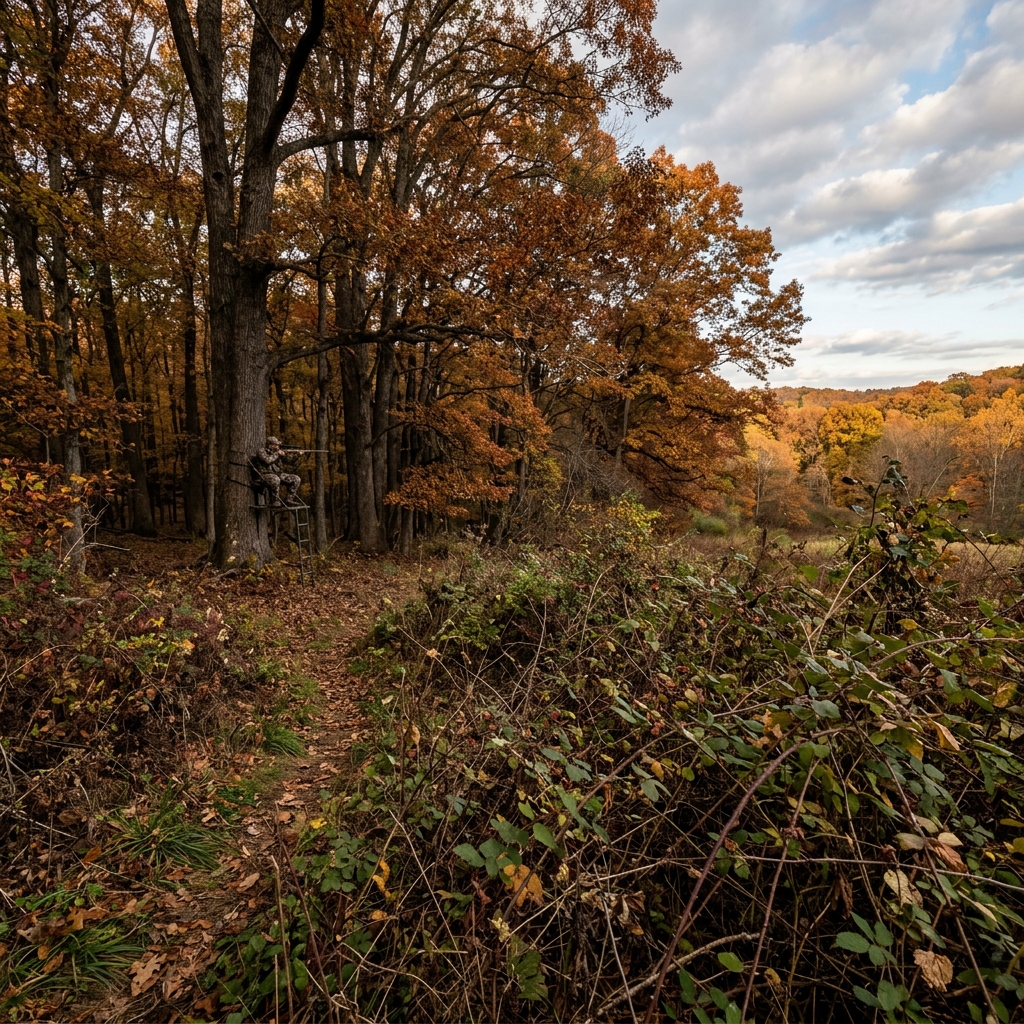
Hunting Habitat Transition Zones: The Ultimate Strategy
Mature deer live on edges. Learn hard vs soft habitat transitions, why bucks travel seams, and how to place stands on pine-to-oak hubs for daylight shots.
The richest deer activity rarely sits in the middle of a 200-acre field or the dead center of unbroken timber. It concentrates where one habitat ends and another begins. Hunters call these seams transition zones—the pine line that meets an oak ridge, the brushy logging cut that butts against mature hardwoods, or the dry cedar stand that drops into a cattail swamp.
Identify those edges correctly and you stop guessing where deer “might” walk. You start sitting where they already prefer to travel. The difference between a season of empty sits and a season of close encounters often comes down to whether you found the seam or the obvious field edge everyone else already knows about.
What Exactly Is a Transition Zone?
A transition zone is any line where two distinct habitat types meet. Some are obvious from a truck window. The best ones are subtle and rarely hunted.
Hard edges are the glaring boundaries: soybeans against timber, a hayfield against a woodlot, a clear-cut against mature forest. They are easy to find on aerial imagery and equally easy for every hunter in the county to hunt. Daylight mature-buck traffic on bare field edges is often thin because pressure concentrates there. Deer learn to stage deeper in timber or move only after dark.
Soft edges are the gold. They sit inside timber—often a 10- to 30-yard-wide change in stem density, canopy height, or understory. Classic examples:
- Open white-oak ridge meeting an 8- to 15-year-old briar thicket
- Pole timber meeting a dense pine plantation
- Maple swamp edge meeting dry upland hardwoods
- Old logging road corridor where sunlight sparks browse inside darker woods
Soft edges give bucks cover, browse diversity, and a travel lane that never shows up as a bright line on a map. That is why they produce more consistent daylight movement than the farm-field edge everyone sits.
The width of a soft edge matters. A gradual change over 80 yards still functions as a seam if stem density shifts enough to create a travel preference. Look for the band where you can see both open-canopy walking and thick escape cover within one bound.
For related terrain thinking, see our guide on whitetail pinch points and funnels.
Why Mature Deer Travel the Seams
Whitetails are edge animals by design. A seam delivers three survival advantages at once.
- Browse diversity. Where two habitats meet, you often get plants from both plus true edge species—greenbrier, honeysuckle, wild grape, raspberry—that thrive in filtered light. That “salad bar” concentrates feeding without forcing a deer into the open.
- Security and escape. A buck can walk in shadow one step inside thick cover while scanning the more open timber beside him. If danger appears, he is already one bound from vanishing.
- Efficient travel. Seams often connect bedding and food more efficiently than bushwhacking through either habitat alone. Over weeks, that creates polished trails, rub lines, and scrapes along the same strip of ground.
Treat the seam as a highway, not scenery. Your job is to intercept traffic where the highway narrows or where wind favors you.
Mature bucks use seams differently than does and yearlings. A 3.5-year-old buck may parallel an edge 15 yards inside cover for a quarter mile without ever stepping into the open side. Does and fawns cross more freely. When scouting, note which trail class dominates—polished 3-inch tracks and rub clusters signal buck traffic worth building a season around.
Hard Edges vs Soft Edges: How to Hunt Each
Hard-edge tactics work best early and late in the day, and mainly when you hunt inside timber rather than on the bald field edge.
- Sit 40–80 yards off the field in the first thick staging cover.
- Favor evening sits when deer stage before dark entry.
- Avoid the “middle of the beanfield” blind unless wind and pressure allow it—and usually they do not for mature bucks.
On hard edges, wind is brutal. A west wind blowing across a north-south field edge can expose you to every deer in the staging timber. Map multiple sets 60–100 yards apart along the same field so you always have a legal wind option.
Soft-edge tactics reward all-day patience during October and November.
- Hang on or just inside the thicker side of the seam.
- Cut 1–3 shooting lanes into the first 10–15 yards of cover, not a parking lot of cleared timber.
- Expect bucks to parallel the edge 5–20 yards inside brush rather than walk the open seam like a sidewalk.
If you hunt both farm country and deep woods, the mindset shift in agricultural edges vs big timber pairs well with transition hunting.
Mapping and Scouting Transition Zones
Start on imagery, finish on foot.
- Aerial pass: Mark color and texture changes—dark conifers vs bright hardwoods, young cuts vs mature canopy, swamp vs dry ground.
- Topo overlay: Prefer seams that also sit on saddles, benches, or creek edges. Habitat change plus terrain pinch multiplies odds.
- Ground truth: Walk the seam looking for tracks, droppings, rubs, and trails that follow the edge rather than cross it once.
- Wind notes: Record which wind lets you enter without blowing through bedding on the thick side.
A productive soft edge often shows a trail that stays within 15 yards of the habitat change for 100+ yards. That parallel trail is your stand line.
When e-scouting, toggle between leaf-on and leaf-off imagery if available. Conifer boundaries show year-round; hardwood-to-thicket seams pop differently after leaves drop. On the ground, carry a compass and walk the seam in both directions. Note where trails bend toward food, where rubs cluster, and where the edge dead-ends at a fence or creek.
To connect seams to daytime security cover, review whitetail bedding areas.
Hunting the Pine-to-Oak Hub
Where mast-producing hardwoods meet dense conifers, you get a classic food-to-cover seam. It is one of the most reliable sets in big timber.
Stand placement mistakes to avoid:
- Too deep in pines: you cannot see or shoot
- Too deep in open oaks: you silhouette and get wind-checked constantly
- Dead center on the bald seam: mature bucks often walk one or two tree rows inside the thicker cover
Better setup: Hang where bark and canopy change. Cut narrow lanes into the first 10 yards of the thick side. Expect parallel travel, not circus-ring crossings.
Sign concentration: Scrapes and rubs often stack along these hubs because every deer class uses them. An active scrape line that tracks a pine–oak edge is worth long sits during seeking and chasing phases.
Oak species matter. White oak and red oak edges draw deer at different times as acorns drop. A pine line meeting a white-oak flat can produce explosive early-season movement. The same seam during the rut may shift to doe traffic between bedding thickets and feeding areas. Re-scout the hub every two weeks in October.
Reading Sign Along the Seam
Transition zones leave a signature if you know what to look for.
Tracks: Parallel trails show repeated edge use. Crossing trails that cut perpendicular once suggest deer moving between blocks, not living on the seam.
Rubs: Fresh rubs on saplings 5–20 yards inside the thick side confirm buck travel. A rub line that tracks the edge for 200 yards is a stand list, not a single tree.
Scrapes: Community scrapes on hubs deserve all-day sits during pre-rut. Overhead licking branches on the thick side often mark the exact lane.
Beds: Oval depressions on south-facing benches along a soft edge tell you deer bed on the seam itself. Hunt the exit toward food, not the bed.
Document sign with GPS pins and wind notes. A seam that looks perfect on a map but shows only old rubs and no fresh tracks in October may be a pressure sink or a night-only route.
Stand Placement, Wind, and Entry Routes
Transition zones fail when entry ruins them.
- Wind: Prefer winds that carry scent into the habitat deer are not using as primary bedding that day.
- Entry: Use creeks, ditches, field edges opposite the seam, or old roads that keep you off the parallel trail.
- Height: 18–22 feet helps on hard edges; soft edges often allow slightly lower stands if canopy breaks your outline.
- Shooting lanes: Cut the minimum. Over-clearing turns a soft edge into a hard edge deer avoid in daylight.
Build a wind rose for each stand: which directions are huntable, which are sacrificial observation-only days. A seam with only one wind option gets burned fast on small properties. Two to four wind-specific sets along a half-mile seam beats one “do-everything” tree.
For concealment details that fit edge sits, see tree stand placement and concealment. Early-season edge feeding patterns pair well with early season whitetail tactics.
Seasonal Timing Along Transitions
| Season | What changes | How to hunt the seam |
|---|---|---|
| Early season | Food-driven, shorter daylight moves | Soft edges near preferred browse/mast; evenings first |
| Pre-rut / rut | Bucks cruise doe habitat | Seams between bedding thickets and doe feeding areas; all-day sits |
| Late season | Thermals and calories dominate | Conifer edges, south-facing soft edges, food-adjacent seams after storms |
Do not lock one stand for the whole season. The seam stays useful; the section of seam that produces shifts with food, pressure, and wind.
During the October lull, seams between bedding and secondary food often outperform primary field edges because bucks reduce daylight exposure. After a cold front in late season, conifer-to-hardwood seams on south slopes can produce mid-morning feeding as deer seek thermal cover and leftover mast.
Frequently Asked Questions
Are field edges still worth hunting? Yes—for does, young bucks, and evening observation. For mature bucks, hunt the staging timber behind the field more often than the bald edge itself.
How wide is a typical soft edge? Often 10–40 yards. If the change is gradual over 100+ yards, treat the densest stem-count band as the travel lane and hang on its downwind fringe.
Should I hunt the thick side or the open side? Usually the thick side for daylight bucks. They parallel inside cover while scent-checking the open timber.
How do I find soft edges on public land maps? Look for timber-type changes, plantation boundaries, old cuts, and wetland edges on forest-type or aerial layers, then verify trails on the ground.
Do transition zones work in flat farm country? Yes. Fence rows, CRP against crop, ditch lines against timber, and CRP–woodlot seams function as transitions even without big elevation change.
How many stands do I need on one long seam? Two to four wind-specific sets along a half-mile seam beats one “do-everything” tree. Rotate to keep pressure low.
Overlook the obvious bald fields when everyone else piles onto them. Find the hidden line where the woods change personality—and you have found where mature bucks prefer to travel.
Wildsnap • Open beta
Join Wildsnap and try the beta
In the open beta, you turn trail-cam data into actionable insights—free, fast, and simple.
No credit card