
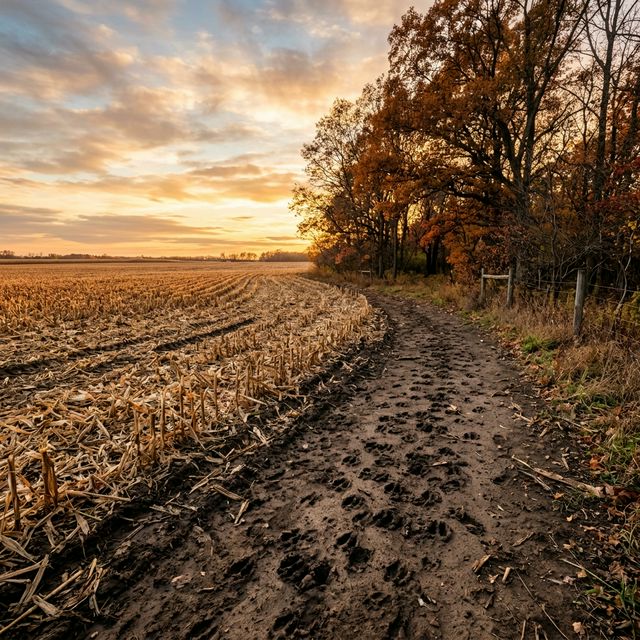
Agricultural Edges vs. Big Timber: Adapting Your Whitetail Strategy
Farm-country field edges and big-timber browse country demand different tactics. Learn staging areas, pinch points, soft edges, and safety for both landscapes.
A four-year-old buck on an Iowa bean field does not live like a four-year-old buck in a Maine cedar swamp. Food distribution, cover continuity, and pressure reshape daily circuits. If you run the same “sit the field edge” playbook everywhere, you will fail half the time.
Adapt to the landscape: destination agriculture versus nomadic big timber.
Ag Country: Destination Food, Staging Bucks
In farm country, corn, soybeans, alfalfa, or winter wheat create concentrated destinations. Deer density is often high. That sounds easy—until you realize mature bucks rarely step into open fields in daylight.
Staging areas (typically 40–80 yards inside timber or CRP thickets) are where bucks pause until dark. Hunt the staging cover, not only the bald fencerow.
Sentry problem: Field-edge sits get busted by does and yearlings long before a target buck moves. One blow and the evening is over.
Tactics that work:
- Evening stands on trails feeding into staging cover
- Morning sits between bedding and the field for return traffic
- Cameras on staging scrapes rather than only field corners
The best ag-country setups intercept bucks 30–60 minutes before they reach the field. Trails that run perpendicular to the crop edge—especially where a finger of timber or CRP juts into the field—compress movement into huntable zones. A buck staging behind a 12-acre woodlot corner is a different animal than one walking a half-mile of open fencerow.
Edge biology overlaps habitat transition zones. Bedding links are in understanding bedding areas.
Reading Farm-Country Sign
Ag landscapes produce sign that is easy to see but easy to misread.
Heavy trails running directly to a bean field usually belong to does and yearlings on a predictable feed circuit. Mature buck sign—larger tracks, rubs on exit routes, isolated scrapes in staging cover—often sits 50–100 yards off the field in thicker timber.
| Sign type | What it often means in ag country |
|---|---|
| Wide trail to field edge | Doe group feed line |
| Rub line parallel to field, 60 yards in | Buck staging route |
| Scrape cluster in CRP thicket | Pre-rut staging hub |
| Crop damage in standing corn | Feeding zone—not always a shootable pattern |
During the rut, mature bucks may cut through staging cover during daylight to check doe groups near fields. That is when a stand 80 yards off the beans beats a field-edge blind, even with perfect wind at last light.
Big Timber: Browse Circuits and Pinch Points
In contiguous forest—northern New England, UP timber, Appalachian big woods—there is often no 100-acre bean field. Food is scattered browse, mast pockets, and cuts.
Bucks may travel miles daily. Sitting a random oak and “waiting them out” can mean weeks without a sighting.
Hunt terrain that condenses travel:
- Saddles
- Creek crossings
- Cliff bases and benches
- Swamp edges
- Logging-road soft edges
See whitetail pinch points and funnels. Soft edges inside timber (pine meeting cedar, cut meeting pole timber) replace agricultural hard edges.
Calorie math is ruthless in winter: deer need efficient routes between thermal cover and browse. Your stand should sit on those routes, not scenic overlooks.
In big timber, one saddle between two drainages can funnel every deer on a 200-acre bench through 40 yards of cover. Finding that saddle requires map work first, boot work second. Aerial imagery reveals cuts, wetland edges, and elevation changes that are invisible from any single stand location.
Soft Edges in the Big Woods
You will not glass a corn wall. You will hunt subtle changes:
- Open pine plantation against tangled cedar
- 3- to 8-year-old clear-cut against mature hardwoods
- Abandoned logging grade with sunlight and browse
These seams offer security plus mouth-level woody forage. Treat them like linear funnels: parallel trails, rub lines, and wind-specific sets.
A 5-year-old clear-cut regenerating with blackberry, maple sprouts, and aspen suckers can hold deer all day during early season. The soft edge where that cut meets standing timber becomes a travel line—especially during the rut when bucks cruise between doe pockets in the mature timber.
Still-hunting these soft edges on windy days produces results when stand hunting open timber fails. See still-hunting and spot-and-stalk for pace and approach tactics that translate directly to big-woods edges.
Scouting Differences That Matter
| Task | Ag country | Big timber |
|---|---|---|
| E-scouting | Field corners, CRP fingers, ditches | Saddles, benches, wetland edges, cuts |
| Cameras | Staging cover & scrapes | Creek crossings & soft edges |
| Sign reading | Trails to fields, rubs on exits | Track circuits, browse lines, rub routes |
| Pressure | Many hunters on same edges | Access difficulty; get-in distance |
Start with e-scouting whitetails, then confirm on foot without burning core cover.
In ag country, a single afternoon walk along field edges can reveal 80% of your season plan. In big timber, expect multiple scouting trips across weeks—sometimes months—before you identify a reliable travel node. The payoff is less competition and less educated deer when you finally find the right saddle.
Gear and Sit Style Adjustments
Ag country: Lighter packs, shorter walks, more evening field-adjacent sits, decoys sometimes useful on edges, higher odds of multiple deer in view.
Big timber: Navigation tools (map + compass, not phone-only), denser layers, still-hunting skills, longer access, fewer sightings per hour but higher meaning per track.
In timber, one fresh mature track in the right saddle can beat twenty field-edge does for planning value.
Ag-country hunters can often run-and-gun between stands on different wind directions within a single morning because access is quick. Big-timber hunters may hike 45 minutes one way to reach a single saddle—planning one sit per half-day is realistic.
Pack weight differs accordingly. Ag: stand, bow or rifle, light layers, water. Timber: all of the above plus emergency shelter, extra calories, compass, headlamp, and first-aid you might actually need if you twist an ankle three miles from the truck.
Seasonal Pivots in Each Landscape
Ag early season: Pattern field food; hunt staging. Ag rut: Bucks cruise doe bedding near fields; ditch the open edge for timber funnels between doe groups. Ag late: Remaining standing crops and south-facing edges after storms.
Timber early: Mast flats and cut browse. Timber rut: Big funnels between doe pockets; all-day saddle sits. Timber late: Conifer thermal edges and yards; track in snow when available.
The calendar changes; the need to match food distribution never does.
Late-season ag hunts often concentrate on the last standing corn or cut soybean fields with adjacent thermal cover. Late-season timber hunts shift to conifer-dominated benches and south-facing slopes where deer can feed and absorb warmth on a 35°F afternoon.
If your property includes both ag fields and a timber block, treat them as separate zones with separate stand inventories. The wind that makes the bean-field staging set perfect may be wrong for the saddle 400 yards behind the barn.
Landscape Safety: Farms vs Wilderness
Agricultural hazards: Combine and tillage traffic. Tell the farmer where you sit. Never assume operators see a blind in dust and noise. Watch for hidden wire, irrigation gear, and chemical application days.
Big timber hazards: Getting lost is lethal, not embarrassing. Carry a battery-independent compass and paper topo. Phone GPS dies in cold. Watch for forgotten barbed wire from old homesteads. Tell someone your route and return time.
Farm-country hunters face vehicle and equipment risks that timber hunters rarely encounter. A combine moving through standing corn at dusk does not stop for a camo silhouette. Establish a clear communication line with landowners about which fields are active and when.
Timber hunters face navigation and exposure risks. Hypothermia in a November rain at 42°F is a real threat when you are two hours from the truck and your phone is at 4%. The fix is not more gear—it is telling someone your planned route and hard return time, then honoring that deadline.
Frequently Asked Questions
Can I hunt field edges at all for mature bucks? Yes—especially with perfect wind at last light, or during low-pressure weekdays. Staging timber still wins more often.
How far do big-timber bucks travel? Circuits of several miles are common when food is sparse. That is why pinch points matter more than a single oak.
Is deer density always higher in ag country? Often, but not always. Poor cover or heavy pressure can empty fields; quality timber with browse cuts can hold surprising numbers.
Should my camera strategy change? Yes. Ag: staging and scrapes. Timber: crossings and soft edges—not only abandoned logging landings with no funnel value.
Which is “easier”? Ag offers more sightings and logistics ease. Timber demands navigation and patience. “Easier” depends on your skills, not the postcard.
Can the same property include both? Absolutely. Many farms have a timber block behind the beans. Hunt each zone with the matching playbook on the right wind.
Play the wind everywhere. Then adapt the food logic: intercept staging bucks behind destinations in farm country, and pinch nomadic travel in big timber. The landscape writes the rules—you just have to read them.
Wildsnap • Open beta
Join Wildsnap and try the beta
In the open beta, you turn trail-cam data into actionable insights—free, fast, and simple.
No credit card