
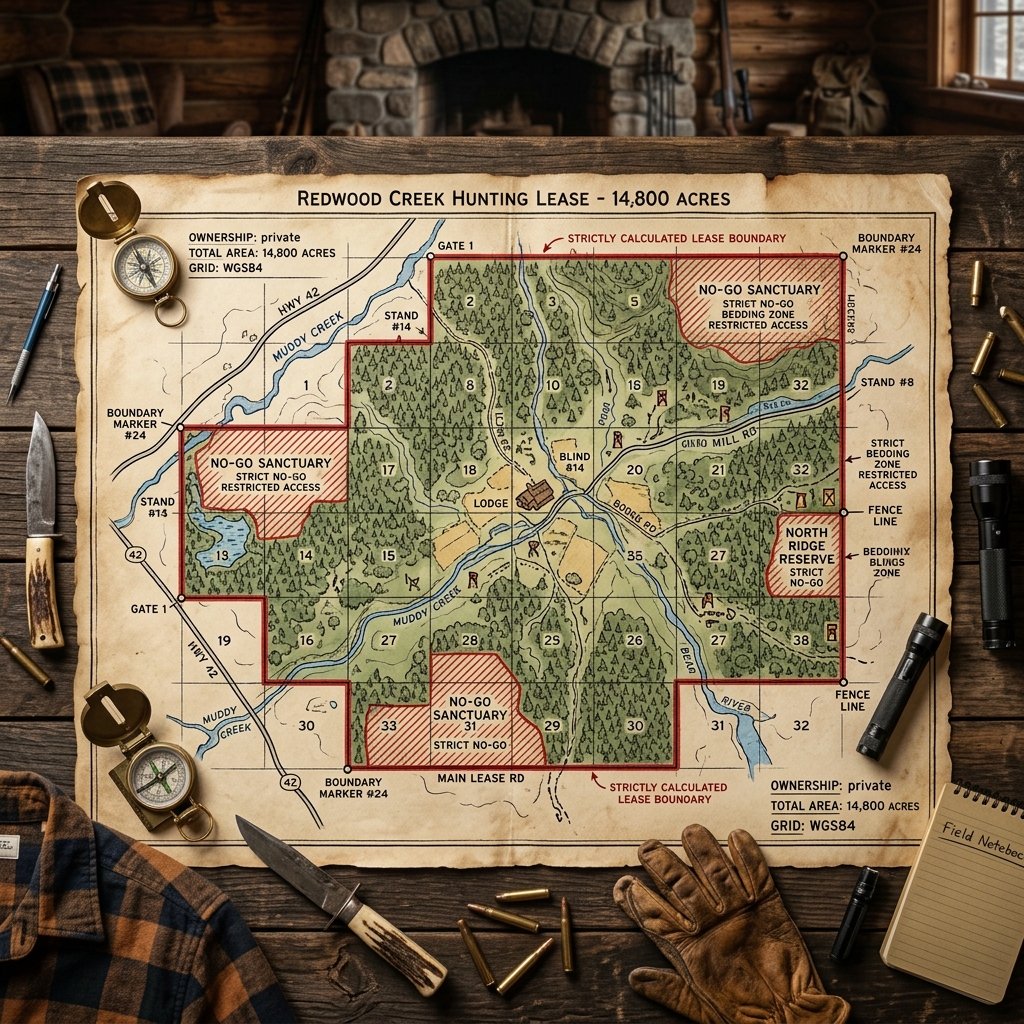
Managing Hunter Pressure: The Mathematical Science of Hunting Leases
Keep a hunting lease productive with sign-in boards, stand-rest rules, sanctuaries, and hunter-per-acre ratios that prevent nocturnal bucks.
Landing a private lease or club feels like a dream until five enthusiastic hunters pound the same 100 timber acres every October weekend. Mature bucks do not always “leave the county”—they go nocturnal, and your expensive access turns into night-only trail-cam entertainment.
Managing cumulative human pressure is the difference between a property that produces for a decade and one that dies in two seasons. Rules feel annoying until you watch daylight movement return.
Erase the Human Signature
The goal is not merely hunting—it is hunting without teaching every deer the weekly schedule of your club.
- Sign-in / tag board: Before dark-thirty departures, each hunter pins intended stand or zone on a shared map. Prevents leapfrogging and double-booking the same funnel.
- 24-hour stand rest: If a site was hunted evening, it sits idle the next morning. Scent and disruption need time to clear.
- Designated access trails: One or two raked or mowed paths beat random bushwhacking. Deer learn to skirt a predictable human trail instead of abandoning the block.
- Parking discipline: Same two truck pads, lights pointed away from bedding, doors closed quietly.
Write rules down. Handshake policies evaporate when a 150-inch buck shows up on camera.
Sanctuaries as the Property’s Savings Account
Designate 20% to 25% of the acreage as off-limits year-round: no hunting, no shed walks, no camera checks through the core. When opening firearms weekend erupts next door, deer pile into the quiet block.
Hunt the edges and exit trails—not the bedroom. For design details on small farms, see whitetail sanctuaries on small parcels. On larger leases, one big core usually beats three tiny “kinda off limits” patches.
Hunter-to-Acre Ratios
Topography matters, but baselines help lease managers say no:
- Gold standard: About 1 active hunter per 40–50 acres of quality cover (not just deeded pasture).
- Danger zone: Four hard-hunting adults on 100 open acres will nocturnalize mature bucks fast.
- Guest policy: Count guests as hunters. A “quiet” Saturday with six extras is a pressure bomb.
If dues only work by overcrowding, you are funding nocturnal deer. Raise dues or trim roster before you ruin the timber.
Stand Rotation and Seasonal Calendars
Pressure is not only body count—it is repeat intrusion.
| Period | Pressure rule of thumb |
|---|---|
| Early season | Limited sits on summer patterns; rest after contact |
| October | Rotate zones; protect sanctuaries hard |
| Rut | More all-day sits OK if access stays clean |
| Late season | Food-focused; fewer hunters, longer sits |
Track which zones were hunted each week. A shared spreadsheet beats memory. Pair rotation with smart trail camera data habits so decisions use daylight proof, not campfire lore.
Access, Wind, and Thermal Rules
Club-wide wind rules prevent “I only had today” disasters:
- No hunting a stand when wind blows into the sanctuary or primary bedding.
- Morning entry cannot cut evening deer trails on the way in.
- ATVs stay on designated paths—or stay on the trailer.
Teach new members scent control basics before they burn a ridge for everyone.
Harvest Rules That Protect the Future
Pressure management includes what you shoot:
- Doe harvest targets based on habitat and neighbor density—not egos
- Optional antler restrictions if the club agrees and state law allows
- Mandatory quartering/drag plans so wounded deer are not left for “tomorrow”
- Same-day reporting to the group text or board
A lease without shared ethics becomes a race to shoot the first legal buck every opening morning.
Common Lease-Pressure Failures
- No sign-in board, three guys on the same oak flat
- “Sanctuary” that someone hunts whenever they see a rub
- Trail cameras checked by walking bedding weekly
- Opening weekend stacked with every member plus guests
- Refusing to rest stands after a busted sit
- Ignoring fitness and pack-out plans so recoveries turn into midday stampedes through the core
Startup Checklist for a New Lease Season
- Map zones, sanctuaries, and access trails
- Install sign-in board at the gate or cabin
- Publish stand-rest and guest rules
- Set hunter caps per weekend
- Agree on doe goals and buck criteria
- Schedule one midseason pressure review meeting
Mobile gear helps members adjust without cutting new trails every week—ground blinds and saddles beat dragging climbers across every ridge.
Trail Cameras Without Adding Pressure
Cameras are tools; checking them can ruin the lease.
- Prefer cellular units on primary scrapes and funnels.
- Batch SD checks to rainy midday walks on designated paths only.
- Ban “quick loops” through bedding after work.
- Share a monthly photo digest in the group chat so five guys are not each walking to the same card.
- Point cams to avoid capturing hunter faces/vehicles if theft or privacy is a concern—secure locks still matter.
Conflict Resolution and Member Buy-In
Pressure rules fail when dues-paying members feel blindsided.
- Hold a spring meeting: review last season’s daylight trends and wounded/lost deer.
- Vote on guest caps and sanctuary maps before September.
- Create a simple strike system for repeat rule breaks (e.g., hunting rested stands).
- Offer mentor sits for new members so they learn access trails correctly.
- Celebrate doe harvest and mature-buck restraint publicly in the club—culture beats laminated rules alone.
If the lease is overcrowded financially, present the math: nocturnal cameras versus raising dues $200 and dropping two spots. Most serious hunters will pay for quality.
Field Notes and Practical Numbers Use these benchmarks to keep decisions concrete rather than vague:
- Log every sit with date, wind direction, temperature, and deer observations—patterns appear after 8 to 12 recorded hunts on the same property.
- Limit first-time pressure on a hot pin to one quality sit, then rest at least 24 to 48 hours unless the rut calendar demands otherwise.
- Carry a short checklist in your phone notes so gear and safety steps do not depend on memory at 4:30 a.m.
- Revisit your plan weekly during the season; crops, pressure, and breeding phases change the right answer.
- When in doubt, choose the option that leaves mature deer less educated for the next sit—longevity beats one burned encounter.
These habits compound across a season and across years on the same ground.
Successful hunters treat preparation as part of the hunt itself. Write down what worked, what failed, and what you will change next time. Small improvements in access, timing, and patience usually matter more than buying another gadget. Stay flexible after weather swings, keep safety non-negotiable, and measure success by clean opportunities and ethical recoveries—not only by antlers on the wall. Over a full season, disciplined routines outperform random hard hunting.
Opening Weekend Protocol The highest-risk 48 hours deserve a written plan:
- Cap hunters per zone; no doubling the roster with surprise guests.
- Assign morning and evening waves so access trails are not highways at once.
- Ban ATVs except for medically necessary or recovery use.
- Require blaze and radio/check-in if firearms season overlaps.
- Hold a 30-minute debrief Sunday night: what got bumped, which stands need rest.
Clubs that survive opening weekend without torching the sanctuary usually have a productive November. Clubs that free-for-all rarely recover daylight movement before late season.
Frequently Asked Questions
How many days per week should one stand be hunted?
Often one quality sit, then rest at least 24 to 48 hours—longer if deer snorted or circled downwind.
What if members rebel against sanctuaries?
Show camera data: daylight use on edges versus dead timber that gets walked daily. Properties without buy-in rarely hold mature bucks.
Should we allow shedding in March?
Edge shed hunts are safer than grid-walking the core. Many clubs ban sheds in sanctuaries entirely.
Do cellular cameras replace the need for rest rules?
No. Cameras reduce some traffic, but hunting pressure still educates deer. Rest rules still matter.
Is 40 acres per hunter realistic for cheap leases?
If not, accept more modest expectations or lease more land. Crowding is a choice with biological consequences.
Great leases are managed, not discovered. Cap footprints, protect a dark core, rotate stands with discipline, and the same acres will keep giving daylight opportunities long after unmanaged clubs go night-only.
Wildsnap • Open beta
Join Wildsnap and try the beta
In the open beta, you turn trail-cam data into actionable insights—free, fast, and simple.
No credit card