
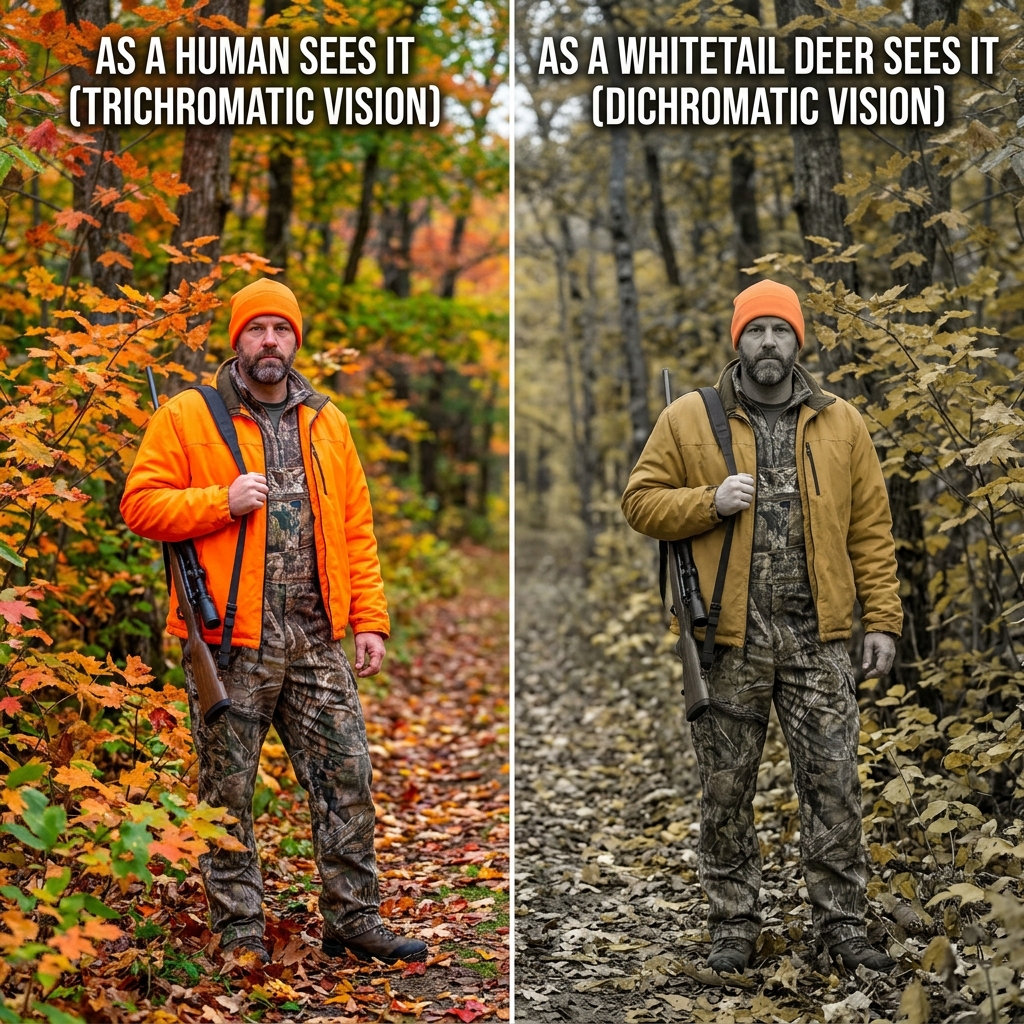
Whitetail Vision: What Colors Can Deer Actually See?
Deer miss blaze orange but light up blue and UV-bright fabric. Learn dichromatic vision, night sight, motion detection, and how to dress so you stay unnoticed.
You sit still in blaze orange and a buck feeds at 20 yards. The next afternoon you wear blue jeans and get blown out at 80. That is not luck—it is biology. Whitetail eyes are built for motion detection and low light, not for admiring sunsets the way human eyes do.
Understanding deer vision changes how you wash clothes, pick layers, raise a bow, and sit a stand. Pair color knowledge with camouflage science, scent control, and smart tree-stand concealment. Vision is one defense; hearing and nose complete the triangle—see also whitetail hearing.
Dichromatic Vision: Two Cones, Not Three
Humans are trichromatic—retinas use three cone types (roughly red, green, and blue). Whitetails are dichromatic: one cone set peaks in short wavelengths (blue/UV) and another in middle wavelengths (green/yellow).
They lack long-wave cones that process red and orange well. Practically:
- Red and orange register as muted gray, yellow, or brownish tones
- Blue and ultraviolet jump out relative to how dull they look to you
- Fine color discrimination in the red-orange band is weak compared with humans
Think of deer vision as similar to red-green colorblindness (deuteranopia), with extra sensitivity on the blue/UV end of the spectrum. That single fact explains most “they stared through my orange but spooked at my jeans” stories.
Why Blaze Orange Works for Safety
Blaze orange is obvious to trichromatic human eyes and muted to deer. That is why it is the standard firearm-season safety color: other hunters see you; deer largely do not experience neon the way you do.
Important caveats that still matter:
- Orange creates a solid blob if it contrasts hard against broken cover—outline still counts
- Mesh or patterned orange can break outline better than a solid sheet in some setups
- Orange does not fix scent, noise, or sudden motion
- Always follow state legal requirements regardless of deer vision science
Wear required orange without fearing that deer see a glowing pumpkin. They do not process that wavelength like a human hunter does.
Blue Jeans and UV Brighteners: The Real Danger Zone
Deer are highly sensitive to blue and near-UV light. Problems show up in two common ways:
- Blue denim and cool-toned fabrics — to a deer, these can appear far brighter than they look to you in the timber.
- Laundry UV optical brighteners — many household detergents add agents that make clothes “whiter and brighter” under UV. In low light, that glow sits exactly where deer vision is strong.
Practical laundry rules:
- Wash hunting clothes in UV-free hunting detergent
- Skip fabric softener brighteners and scented dryer sheets
- Wash new camo before the first hunt—factory finishes often fluoresce
- Store layers in a sealed tote away from household cleaners and fuel cans
- Retire blue jeans as stand pants; save them for the truck ride home
If you only change one habit this season, kill UV brighteners and blue outerwear.
Night Vision and the Tapetum Lucidum
A deer’s pupil is a wide horizontal slit that gathers a lot of light. Behind the retina sits the tapetum lucidum—a reflective layer that sends unabsorbed light back through photoreceptors a second time. That is the eyeshine you see in headlights.
Estimated night sensitivity is on the order of ~18× better than human night vision in practical terms. In the last minutes of legal light, you are squinting while the deer still resolves the woods clearly. Move slower at dawn and dusk than your eyes suggest is necessary. Draw only when the head is down or behind cover—even if you “feel” invisible in the gray light.
Field of View vs Depth Perception
Eyes on the side of the head give deer roughly 300–310° of panoramic view. They can monitor almost behind themselves without turning. The tradeoff is weaker binocular overlap up front—and poorer depth perception than a forward-facing predator.
The head bob explained
When a deer stares and bobs its head up, down, or side to side, it is generating parallax—comparing angles to estimate distance. It is not idle curiosity. Freeze during the bob. Move only when feeding resumes or the head turns away.
The stillness rule
If you freeze when a deer looks your way, poor depth perception often fails to separate you from the trunk behind you. Motion is the trigger that resolves you as a predator shape. Raise binoculars or a bow only in covered moments.
Peripheral advantage
Because they see so much behind them, “sneaking” from the rear still fails if you step into their side-view cone or crunch leaves. Quiet feet matter as much as camo.
Motion, Glint, and Outline
Color is only one channel. Deer also key on:
- Sudden hand, bow, or rifle movement
- Face shine, glasses glare, and phone screens
- Hard vertical outlines on bare trunks
- Fabric flutter on windy sits
- Metal hardware flashing in low sun
Break your outline with cover behind your shoulders and head. Dull metal. Keep phones dark. Practice drawing in one smooth move when the deer’s eyes are occupied. A perfect camo pattern with constant fidgeting loses to average camo and iron stillness.
Practical Clothing and Stand Checklist
- Avoid blue jeans and bright blue rain gear in the stand
- Use UV-free wash on all outer layers and packs
- Meet blaze-orange legal requirements without stress over deer “seeing neon”
- Pick camo that matches breakup distance for your habitat and season more than brand hype
- Cover skin with a face mask or paint if you hunt close timber
- Keep movement economy higher than camo perfection
- Sit with bark, branches, or a trunk shadow behind you—not skylined on a ridge edge
Dawn, Dusk, and the Draw Window
Legal shooting light is when human eyes are weakest and deer eyes are strongest. Plan your shot sequence before the deer arrives:
- Know where your bow hangs or rests so you are not fishing for it in gray light.
- Pre-clear the draw path—no brush slap on the upper cam.
- Decide which landmark equals your max yardage so you do not invent a number at last light.
- If you cannot clearly see the shoulder crease and your pin, the shot is over—period.
Many “mystery misses” at dusk are vision problems on the hunter’s side: glowing pins against dark fur, glasses fog, or a rushed draw while the deer stares. Give yourself an earlier last-light cutoff than the legal minute on the app.
Training Your Own Movement Discipline
You can practice stillness without a deer present. On summer evenings, sit a practice stand for 30 minutes and rehearse:
- Raising binoculars only when a fake “deer” (a marked stump) looks away
- Drawing to anchor in one motion on a whispered countdown
- Freezing for a full 60 seconds after any noise you make
Video yourself once. Most hunters are shocked by how much they fidget. Cutting that motion in half does more for close encounters than buying a new camo pattern. Pair the drill with quiet gear checks from your pre-season gear prep routine so nothing squeaks when it counts.
Frequently Asked Questions
Does camo wash really matter? Yes. Standard brightening detergents can make clothes fluoresce in wavelengths deer see well. Hunting-specific, UV-free detergents are cheap insurance compared with a blown sit.
Do deer look up into tree stands? They scan the horizon first, but pressured deer absolutely look up—especially after scent or noise. Assume they will check the canopy if alerted.
Can deer see red light on headlamps? Red is harder for them than white or blue-rich light, which is why many hunters use red or dim modes. Still keep output low and avoid shining eyes directly.
Is gray better than green camo? It depends on season and habitat. Late-season gray/brown breakup often beats lush green patterns in bare timber. Match the background you actually sit in.
Will a blaze vest ruin a bowhunt? Usually no from a color-vision standpoint. Outline, motion, and scent matter more. Follow local regs; many archery areas do not require orange until firearm seasons.
Do lighted nocks spook deer? Some hunters worry about the flash. Most deer react to the sound and motion of the shot first. Use what helps you recover ethically; practice so the shot is clean either way.
Stay still, skip blue and UV-bright laundry, and wear your orange with confidence. Neutralize vision first—then scent and sound decide the rest.
Build a cleaner history of your herd
Spend less time sorting and more time seeing what matters—when detections are organized by time and class.
No credit card
Wildsnap • Open beta
Build a cleaner history of your herd
Spend less time sorting and more time seeing what matters—when detections are organized by time and class.
No credit card