
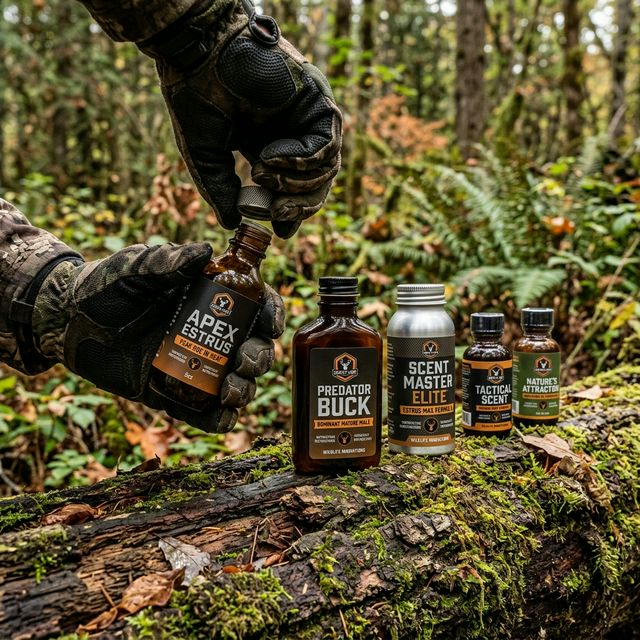
Demystifying Deer Lures: When to Use Estrus vs. Buck Urine
Learn when to use estrus, buck urine, and curiosity scents. Match deer lures to the season, stay CWD-legal, and apply scent-drags that work.
The scent aisle in October is a wall of promises: tarsal, doe-in-heat, dominant buck, curiosity blend. Used on the right week, lures can tip a fence-line buck into bow range. Used on the wrong week, they read as a neon danger sign to a nose that processes scent better than you ever will.
Lures are a high-risk, high-reward tool. Match the chemical story to the biological phase—or leave the bottle in the truck.
What Types of Deer Lures Actually Exist?
Most products fall into four jobs:
- Curiosity / cover scents — food aromas, curiosity blends, or scent elimination companions
- Territorial / buck urine & tarsal — “another buck is here” challenge
- Estrus / doe-in-heat — sexual lure timed to peak breeding
- Specialized glands — forehead, interdigital, etc. (niche use)
If the label can’t tell you which job it does, skip it.
Natural vs. Synthetic: What’s the Smart Choice Now?
Chronic Wasting Disease (CWD) changed the rules. Many states restrict or ban natural deer urine because prions can theoretically hitchhike in bodily fluids.
| Type | Pros | Cons |
|---|---|---|
| Natural urine | Potent, traditional | Short shelf life, rancidity, CWD legality issues |
| Synthetic | CWD-legal in more areas, stable, consistent | Some bucks ignore weak formulas |
Practical recommendation: default to quality synthetics unless your state allows natural products and you store them cold. Check current regs every season—Pennsylvania, Michigan, Minnesota, and others have had significant restrictions.
Wash hands after handling. Some carriers irritate eyes and cuts.
When Should You Use Buck Urine or Tarsal?
Territorial scents fit pre-rut and early seeking, roughly when rubs explode and scrapes go hot—often mid-to-late October in much of the Midwest (shift earlier/later by latitude).
Best uses:
- Mock scrapes and real scrape licking branches
- Entry routes where you want a buck to pause broadside
- Combo with light rattling / tending grunts
Avoid: dumping dominant buck scent in a nursery-area doe bedding sanctuary in early September—you may bump patterns before you have a shot.
For timing context, see Hunting the Pre-Rut Seeking Phase and How to Create a Mock Rub Line.
When Does Estrus Actually Work?
Estrus is not an August product. Peak effectiveness aligns with peak conception windows—often 2–3 weeks spanning the primary rut in your region.
High-odds windows:
- Seeking phase into lockdown
- All-day sits during cold fronts in peak rut
- Scrapes still being refreshed as bucks cruise doe bedding edges
Low-odds windows:
- Early season (curiosity may work; estrus usually won’t)
- Post-rut when most does are bred—switch toward food-based strategies (Post-Rut Late Season Food Sources)
A bottle of estrus in the wrong month educates mature bucks: human + fake heat = leave.
How Do You Run a Scent-Drag the Right Way?
The scent-drag remains one of the cleanest applications.
- Tie a felt wick or drag rag to 4–6 feet of string.
- Saturate with estrus or buck lure appropriate to the date.
- Drag from a downwind entry, crossing expected travel routes.
- End the trail at a shot window 15–25 yards from your stand—not under your boots.
- Hang the wick 4–5 feet high near a licking branch or decoy if using one.
Dose: damp, not dripping. Over-application smells like a chemistry lab.
Pair with aggressive visuals in late October using tactics from Using Decoys During the Pre-Rut and Decoying Whitetails.
How Do Lures Interact With Scent Control?
Lures don’t replace scent control—they layer on top of it.
- Play the wind first; lure second
- Store bottles outside your cabin clothes tote
- Touch wicks with gloves
- Don’t drip lure on stand platforms you touch with bare hands
If a buck smells you and estrus, he smells a trap. Build your baseline with Whitetail Scent Control.
What Mistakes Make Deer Lures Backfire?
Avoid these:
- Using estrus on opening weekend of early bow season “just because”
- Refreshing the same wick every sit until the woods reek
- Placing scent where you can’t shoot when a buck commits
- Ignoring legal bans and risking fines
- Believing lure substitutes for scouting—cameras and sign still rule (Trail Camera Placement During the Rut)
Lures tip close decisions. They rarely create deer that weren’t already living nearby.
How Do You Build Mock Scrapes That Support Lures?
A bottle without a visual story underperforms. Mock scrapes give bucks a reason to stop.
Basic mock scrape (30 minutes):
- Choose a licking branch 5–6 feet high over a trail edge or saddle.
- Clear a 2–3 foot circle of leaves to bare dirt.
- Rough the soil with a stick (not your boot scent if you can help it).
- Add a light synthetic buck urine dripper or gel on the branch/soil.
- Place a camera 8–10 feet away at a 45° angle for inventory.
Refresh drippers every 7–14 days early, then less once the scrape is adopted. If a mature buck starts daylight-checking it, stop tinkering—hunt it. Over-maintaining scrapes is how you turn a pattern into a night-only tour.
During seeking phase, pair the scrape with a short grunt or rattling sequence only when a buck is in sight. Blind calling over a lure-soaked scrape for hours often educates more than it attracts.
Curiosity Scents: When Do Food and Cover Aromas Help?
Not every sit needs urine. Early season and late season often favor curiosity or food-based aromas over sexual lures.
Useful cases:
- Soft mast scent near a transition in September
- Apple or acorn curiosity blends on a community scrapeless travel route
- Cover scent as a confidence tool on entry—not a substitute for wind
Keep expectations modest. Curiosity scents may stop a deer for a 5-second pause—the exact pause you need to settle a pin. They won’t pull a bedded 160-inch buck 200 yards in a heat wave.
How Do You Sequence Lures Across a Full Season?
Think in phases, not bottles:
Early season (Sep–early Oct): Skip estrus. Use curiosity/food aromas sparingly or nothing. Wind and food sources do the heavy lifting.
Pre-rut (mid–late Oct): Buck urine and tarsal on scrapes and mock scrapes. Light rattling. Challenge, don’t romance.
Peak rut: Estrus drags and scrape maintenance make sense. Doe-in-heat near travel edges. Keep doses modest.
Post-rut / late season: Sexual lures fade. Return to food. A buck fighting to survive a 5°F night cares more about corn than perfume.
Write the phase on a piece of tape on each bottle in your pack so you do not grab estrus on a 75°F September afternoon out of habit. Habit is how mature bucks get educated.
Also rotate wick locations. Hitting the exact same branch with the same lure for 14 straight sits creates a stale “human chemistry station.” Move the drag end-point 10–20 yards when you rehunt a funnel.
Do Calling and Lures Compete or Combine?
They combine when timed correctly. A buck that hears a tending grunt and then cuts a fresh estrus drag has a story that matches. A buck that hears continuous rattling while standing in a puddle of last week’s rancid urine gets a story that screams trap.
Use sound to start the look, lure to finish the walk, and silence once he commits. If he hangs up, one soft grunt beats a second scent bomb. Store bottles out of direct sun in the truck box so summer heat does not cook synthetics into something deer ignore.
Frequently Asked Questions
Is doe pee the same as estrus?
Not always. “Doe urine” may be non-estrus. Estrus products claim heat-cycle pheromone profiles. Read labels and match to rut timing.
How long does a wick stay effective?
Often 1–3 days depending on heat, sun, and rain. Synthetic usually outlasts natural. Refresh when scent is faint at arm’s length—not every hour.
Can lures help on public land?
Yes, in moderation—especially mock scrapes and short drags. Heavy scent bombing on pressured ground can look unnatural fast.
Should I use scent with a buck decoy?
Often yes during pre-rut: light buck urine or tarsal near the decoy supports the visual challenge. Keep doses subtle.
What’s better—canister drippers or drag rags?
Drags control where the trail leads. Drippers maintain a scrape over days. Many hunters use both: dripper on the scrape, drag on entry.
Match the bottle to the calendar, stay CWD-legal, and let the wind stay boss. Used with discipline, lures are a nudge—not a magic spell.
Wildsnap • Open beta
Join Wildsnap and try the beta
In the open beta, you turn trail-cam data into actionable insights—free, fast, and simple.
No credit card