
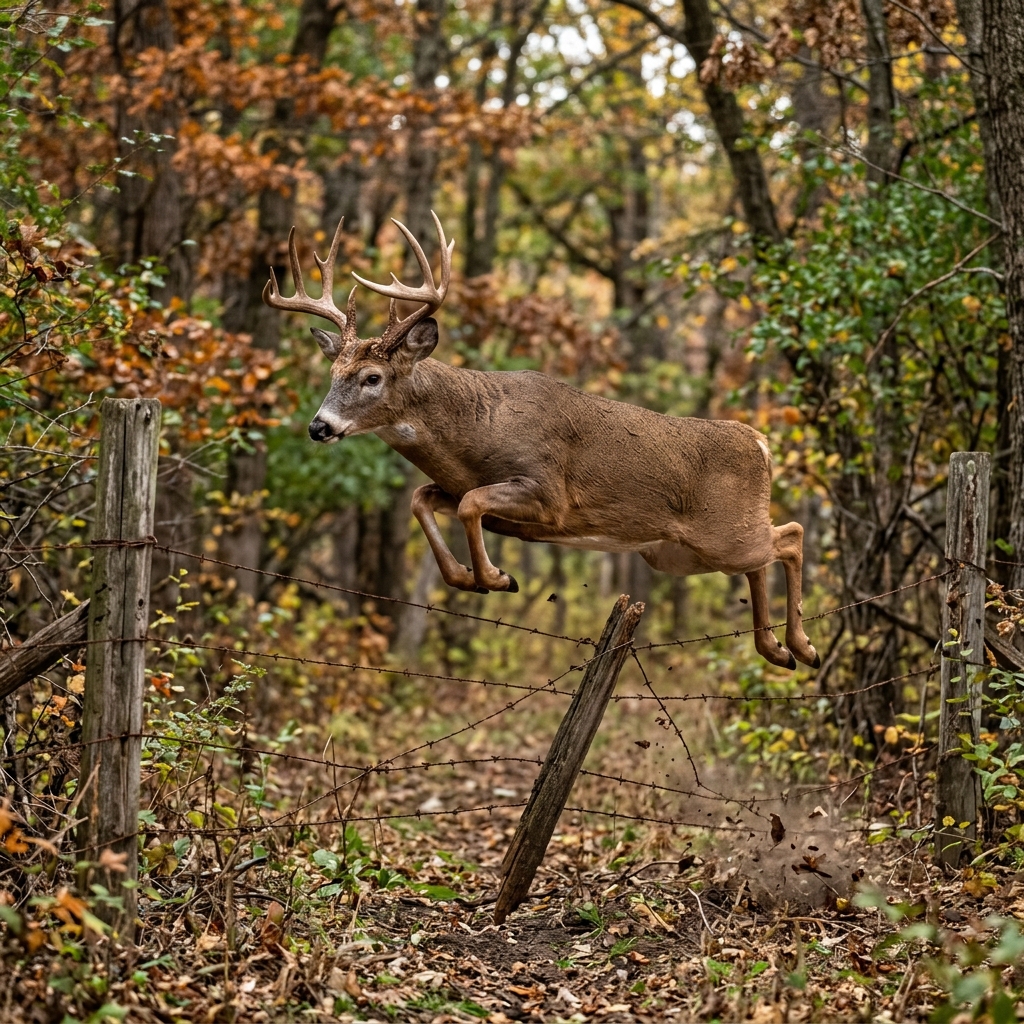
Mastering Natural Funnels: Hunting Tight Fence Jumps and Deep Ditches
Find fence jumps, ditch washouts, culverts, and ridge saddles that pinch deer into predictable 10-yard lanes for close archery shots on small properties.
Deer conserve calories. They rarely travel a hard straight line when an easier route exists. A natural funnel is any terrain or man-made feature that pinches movement into a predictable lane—often a 10-yard window you can cover with a bow.
Stop hunting “big woods hope.” Start hunting restrictions: fence gaps, ditch ramps, culverts, and saddles. That is how average properties produce close shots.
The best funnel on your farm may look unremarkable from the road—a sag in a barbed-wire fence, a washed-out ditch bank, a narrow gap between two cedar swamps. Deer use these features daily because physics and laziness align. Your job is to find them before opening day and treat them like premium real estate.
What Makes a Funnel Lethal
A funnel works when three things stack:
- Deer need to move between two useful habitats (bedding ↔ food, creek ↔ ridge)
- Obstacles force them through limited crossings
- You can approach with a wind that does not blow into bedding
Funnels fail when pressure sits on them every weekend or when entry routes contaminate the only trail. Hunt them sparingly and with wind discipline.
Not every narrow spot is a funnel. A trail between two oaks is just a trail. A trail between a swamp and a fence with no alternate crossing—that is a funnel. Ask: If I were a deer, would I have to pass here? If the answer is yes, scout it hard.
Broader terrain theory is covered in whitetail pinch points and funnels and habitat transition zones.
Fence Jumps: How Deer Choose the Gap
A healthy adult whitetail can clear roughly 8 feet when panicked. In daily travel, deer are lazy. They prefer:
- Broken top wires
- Collapsed stone-wall sections
- Gates left ajar
- Low spots where wire sags to 4–5 feet or less
- Corners where two fences meet and create a habitual jump
How to find the kill spot:
- Look for U-shaped polish or hair on the top wire
- Find mud trails beating to one narrow gap
- Check both sides for tracks landing in the same 3–5 yard pad
Hang 15–25 yards downwind of the jump, not on top of the landing zone where your scent coats the only crossing. Cut one quiet lane. Expect deer to pause and look before committing.
Walk fence lines in March and August when vegetation is low. Hair on wire persists for months. Multiple gaps may exist; deer usually favor one primary jump and one backup. Camera both before committing a stand.
Corner jumps deserve special attention. Where two fences meet at 90 degrees, deer often hop the lowest corner rather than parallel either fence for hundreds of yards. These stacked corners are bow-range gold on small farms.
Ditches, Washouts, and Bank Ramps
In flat farm country, a steep drainage ditch is a wall. Deer will not randomly leap vertical banks when a ramp exists.
Washout ambush: Erosion creates natural on-ramps. Trails concentrate there. Sit slightly downwind and off the trail so you catch deer as they pause on the rim.
Dry culverts: Paranoid deer sometimes cross under roads or berms through large dry culverts rather than skyline the pavement. Camera these carefully; hunt only with safe backstops and legal access.
Setup distance: About 20 yards downwind of the crossing often yields a stationary broadside as deer crest the bank and survey.
Ditch funnels work on a circuit. Map where deer enter the ditch, where they exit toward food, and where they cross under a road. The exit ramp toward a beanfield at dusk may outproduce the morning bedding entry on the same ditch.
In wet years, ditches that were dry crossings may flood and force deer to a secondary ramp 100 yards away. Re-walk ditches after heavy rain every season.
Creek-focused versions of this geometry show up in hunting river bottoms and creek crossings.
Ridge Saddles: The Elevation Super-Funnel
In hill country, a saddle is the low dip between two higher points on a ridge. Deer cross ridges at the lowest reasonable point to save energy.
Why saddles shine:
- They connect valleys on both sides
- Rutting bucks cruise them while scent-checking
- Prevailing winds are readable if you map both slopes
Hunt tips:
- Prefer saddles linking bedding cover to food or doe groups
- Hang just off the saddle floor on the downwind timber edge
- Avoid skylining yourself on the bald crest
A saddle plus a fence gap or logging-road pinch becomes a rare “stacked funnel.” Those deserve your best wind days—not casual Saturday pressure.
Measure saddle width. A 30-yard throat is archery-perfect. A 200-yard flat saddle is less a funnel and more a crossing zone—still useful, but stand placement must focus on the narrowest timber pinch within the saddle, not the whole depression.
Man-Made Funnels Worth Mapping
| Feature | Why deer use it | Stand note |
|---|---|---|
| Fence jump / break | Lowest calorie crossing | 15–25 yd downwind |
| Ditch washout | Only safe bank ramp | Hunt the rim pause |
| Culvert | Hidden road underpass | Safety + permission first |
| Logging road choke | Soft browse + easy walking | Soft-edge set, not road center |
| CRP lane between woods | Travel corridor | Treat like a linear funnel |
Walk features in the off-season. Mark every crossing with GPS. Build a wind chart: which stands work on SW, NW, E, etc.
Other man-made funnels include: cattle gap bars in a single-lane opening, hay-bale gaps in fence lines, abandoned railroad grades pinching between swamps, and beaver-dam crossings where timber blocks all other routes. See hunting beaver ponds and swamp sloughs for wetland pinch logic.
Scouting Funnels Without Burning Them
Funnels are fragile. One sloppy scout trip can educate every deer using the crossing.
- Walk funnels midday when deer are bedded elsewhere
- Spray down and stay off the trail when possible—parallel the lane 20 yards out
- Use cellular cameras on a two-week delay rather than weekly checks
- Never cut lanes during summer scout; wait until two weeks before hunt
If you find sign on a funnel but cannot hunt it without contaminating entry, mark it for a perfect-wind day only. Sacrificial funnels you never hunt keep primary crossings alive under pressure.
Stand Placement and Shot Geometry
Funnel hunting is close-range hunting. Plan the shot before opening day.
- Pick trees that cover the pause point (rim, landing pad, saddle throat)
- Clear one primary and one emergency lane—not a clear-cut
- Keep bow hangers and pack hooks silent; deer are inside 20 yards
- Practice kneeling/sitting shots if you hunt ditches from the ground
Elevated vs ground depends on terrain. Fence jumps often favor a tree 20 yards off the landing pad. Ditch rims may offer no climbable tree—a ground blind brushed into the bank can be superior.
For concealment that fits tight sets, see tree stand placement and concealment. Small-woodlot hunters should also read strategies for hunting small woodlots.
Pressure Management on Small Properties
The best funnel on a 40-acre farm can be ruined in two weeks of daily sits.
Rules that keep funnels alive:
- Hunt only with perfect wind
- Limit daylight walk-throughs; use cameras sparingly or cellular
- Enter from the non-deer side (creek, neighbor’s ag edge with permission, road ditch)
- Leave when young deer bust you repeatedly—rotate to a secondary funnel
If you own multiple crossings, assign primary and sacrificial sets. Let the herd keep trusting the best one.
On shared hunting clubs, agree in writing which funnels are rotation-only. The fence jump everyone knows about should not get hunted every weekend. Assign wind days like shifts.
Frequently Asked Questions
How high of a fence will deer jump routinely? They can clear about 8 feet when pressed. Daily travel prefers broken or low sections closer to 4–5 feet when available.
Should I hunt directly over the fence jump? Usually no. Sit slightly off to the downwind side so your scent and outline are not plastered on the landing pad.
Are ditches good morning or evening hunts? Both—if they connect bedding and food. Mornings often favor travel back to cover; evenings favor food-bound movement. Match the ditch to the daily circuit.
What is better: saddle or fence gap? Whichever truly pinches your deer. Saddles dominate hill country; fence gaps dominate farm country. Stacked features beat either alone.
Can I build an artificial funnel? Hinge-cuts and brush fences can help on private land, but natural gaps usually look and smell more trustworthy. Do not block legal access or create hazards.
How close is too close for a bow setup? Many lethal funnel sits are 12–25 yards. Closer than ~10 yards increases detection risk unless cover and wind are excellent.
The best stands are not where you once saw the most deer milling around—they are where terrain forces deer into a lane you can cover. Find the restriction, and you have found the X.
Wildsnap • Open beta
Join Wildsnap and try the beta
In the open beta, you turn trail-cam data into actionable insights—free, fast, and simple.
No credit card