
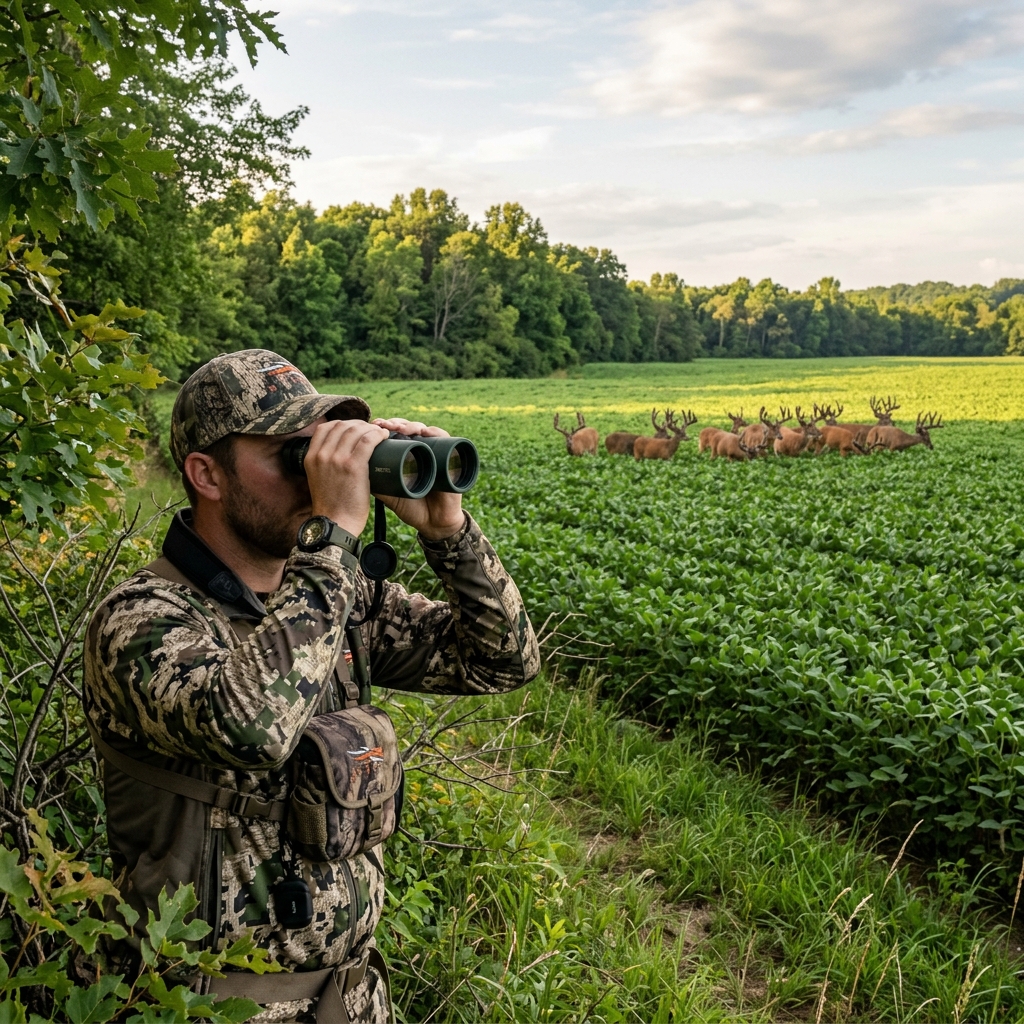
Summer Velvet Scouting: Glassing Bachelor Groups
Build your fall hit list in July and August. Learn how to glass velvet bachelor groups, map entry trails, and turn summer sightings into early-season stands.
While temperatures sit in the 90s and casual hunters head to the lake, serious whitetail hunters treat July and August as prime scouting season. Bucks are at peak antler growth, testosterone is still low, and bachelor groups feed openly on beans, clover, and alfalfa in the last hour of light. That window is the clearest look you will get at every mature buck on or near your ground before September pressure and rising hormones scatter them.
Summer velvet scouting is not about tagging a deer. It is about inventory, food preference, and entry trails you can hunt in September without burning the whole farm.
When Do Whitetail Bucks Form Bachelor Groups?
Bucks typically begin clustering in late spring once antlers sprout and social tension drops. Groups of 3 to 8 bucks—sometimes more on rich Midwest crop ground—feed and bed with little aggression because breeding competition has not started. Extra eyes and ears matter when velvet is soft, vascular, and easy to damage.
Expect bachelor groups to hold through July and most of August. By early September, velvet peels, testosterone climbs, and the social structure breaks. The bucks you glassed together in August may bed miles apart by opening day—but the landscape lines they used to reach food often stay useful.
What Is the Best Time of Day to Glass Summer Bucks?
Daylight glassing is almost entirely an evening game in summer heat.
- Prime window: Roughly 7:00 p.m. until dark, depending on latitude and crop height. Many mature bucks will not step into the open until the last 20 to 40 minutes of legal light.
- Morning value: Limited. Bucks often bed before sunrise after night feeding. Morning glass can confirm a field is used, but evening produces the inventory photos that matter.
- Optics: 10x42 binoculars for scanning; a 15–60x spotting scope on a window mount or tripod for rack detail at 400 to 800 yards.
- Distance: Stay several hundred yards back—truck, fence row, or ridge top. If deer look at you, you are too close.
Pick a high seat overlooking a major food source: soybeans, alfalfa, clover plots, or lush hay. Glass timber edges systematically, not randomly. Start at the corner closest to bedding cover and work the fringe in overlapping sweeps.
How to Build a Summer Hit List Without Spooking Deer
Treat every glassing session like a data collection sit, not a drive-by.
- Log date, time, wind, and field. Note which bucks arrive first and which trails they use.
- Photograph or sketch racks. Velvet makes scoring rough, but relative frame, beam mass, and uniqueness still let you ID individuals later.
- Mark entry and exit. Pin the exact ditch, fence gap, or timber finger where bucks appear. Those spots become early-season stand candidates.
- Limit visits. Two to four quality evening sessions per month on a field is usually enough. Nightly truck glassing from the same pull-off educates deer.
- Stay off bedding. Summer walking through thickets for “just a quick look” can blow a bachelor group off the property for weeks.
Pair field glassing with remote scouting. Trail cameras on field edges and travel corridors fill gaps when you cannot sit every night. Tools like WildSnap help sort species and activity timing so you spend glassing hours on fields that actually produce bucks—not empty green.
Do Bucks Stay in the Same Area After They Shed Velvet?
Usually not in the same social group—and often not on the same exact bed-to-feed line. After velvet sheds in early September, bachelor groups dissolve. Some bucks shift bedding deeper into cover. Crop harvest can erase an entire summer feeding pattern overnight.
Summer scouting still pays because it answers three durable questions:
- Inventory: Which bucks survived winter and are on your landscape.
- Preferred food: Which fields or plots consistently draw the most daylight traffic.
- Topographic lines: Where bucks enter fields. Even if bedding moves, deer often reuse the same ditches, benches, and fence corners when they return to early-season food.
If a 140-inch buck lived in the southwest corner soybeans all August, do not assume he will stand there opening weekend. Do assume he knows that corner, and that a stand 80 to 120 yards into the timber on his entry trail may still be gold for the first cold front of September.
Pairing Glassing With E-Scouting and Cameras
Glassing shows you what is alive. Maps and cameras show you where they live when you are not watching.
Use aerial imagery and topo to find staging cover within 75 to 150 yards of summer food—the shady edge, CRP tongue, or creek bottom bucks linger in before stepping out. Place cameras there, not only on the open field, if you want daylight photos of mature bucks. For a deeper map-first approach, see our guide to e-scouting whitetails.
Cellular cameras reduce disturbance, but even a few SD cards checked monthly beat weekly stomping. Review heat maps of timestamps: if a target buck is 90% nocturnal in August, he may still be killable on the first cool evening when patterns shift—if you already know his trail.
Weather still matters in summer. A 10 to 15°F evening cool-down after a heat wave often pulls bucks into fields 30 to 45 minutes earlier. Cross-check glassing notes with broader deer activity and weather patterns so you prioritize the best nights.
Bachelor Group Behavior Worth Noting
While you glass, watch social cues. Dominant bucks often claim the best forage patches first, but age structure shows in body: swollen necks come later with testosterone, so summer judgment leans on frame, belly line, and antler mass. Younger bucks may feed more boldly in the open; mature deer sometimes stage in the first shade finger and only show tips of antlers until the last light.
Count does and fawns on the same fields. A field full of family groups with occasional buck visits can still be a September goldmine if your stand sits on the buck entry trail rather than the doe circus in the middle. Conversely, a bachelor-only clover plot that goes quiet after velvet shed may be a summer-only pantry.
If neighboring hunters pressure the same field edge, shift your glassing to secondary food 200 to 400 yards away—cut corn later, a hidden alfalfa corner, or a green food plot off the road. The bucks you want often have a backup grocery store already picked out.
Turning Summer Sightings Into Early-Season Stand Sites
A hit list without a plan is just entertainment. Convert notes into hangable locations before leaves drop and access gets loud.
- Hunt the trail, not the field. Early-season mature bucks often hang in staging cover until dark. A stand 60 to 100 yards inside the timber on the entry trail beats a field-edge hang that only sees doe traffic at last light.
- Wind and thermals first. Evening thermals usually fall toward low ground. Hang so your scent drifts away from the bedding and the trail, not across the field where deer will feed.
- Access from the dark side. Enter from the opposite direction of bedding when possible. Park where headlights do not rake the food source.
- Have two setups. One for a SW wind, one for a NW/NE wind. Summer glassing that only works on one wind direction dies on opening day.
- Do not overhunt. Burn a summer-pattern stand two evenings in a row and you may educate the exact buck you spent July inventorying.
If you hunt from elevated stands, place them with concealment and safe access in mind—topics covered in our tree stand placement guide—and never climb without a harness and lifeline.
Mistakes That Ruin Summer Scouting
Avoid these common failures:
- Glassing from too close. Deer that stamp and blow in August will be harder to kill in October.
- Walking food plots at midday “to check.” Your scent stays; the bachelor group may not.
- Assuming every velvet giant is local. Some bucks summer on a neighbor and only visit your ground after crops change.
- Ignoring does and fawns. Heavy doe use marks a secure food source bucks will return to when bachelor groups break.
- Skipping paperwork. Date, wind, and trail notes beat memory when September arrives.
Frequently Asked Questions
When should I start summer velvet scouting?
Late June through August. Peak visibility for mature bucks on crop fields is typically mid-July through mid-August, when antlers look impressive and bachelor groups still feed in daylight.
How far should I be when glassing bachelor groups?
Stay 300 to 800 yards out when terrain allows. Use a spotting scope. If bucks stare, stamp, or leave early, increase distance and change your parking spot.
Will the bucks I glass in August be there in November?
Not reliably. Summer range and rut range often differ. Use summer scouting for early-season patterns and inventory; use scrapes, cameras, and pressure maps for November.
Do I need trail cameras if I glass every evening?
Glassing is excellent for inventory, but cameras catch nocturnal and midday movement you will miss. A few well-placed edge cameras plus selective glassing is more efficient than either method alone.
What optics do I need for velvet scouting?
Quality 10x binoculars and a spotting scope in the 15–60x range cover most Midwest and Southern field setups. A window mount or stable tripod matters as much as glass quality.
Can WildSnap help with summer scouting?
Yes, when you use trail cameras alongside glassing. WildSnap’s AI analysis can identify species and surface activity patterns tied to weather, so you focus evenings on the fields and time windows that actually show bucks.
Confirm seasonal patterns from your cameras
Find patterns and time your hunts right when your camera history tells you what happened — and when.
No credit card
Wildsnap • Open beta
Confirm seasonal patterns from your cameras
Find patterns and time your hunts right when your camera history tells you what happened — and when.
No credit card