
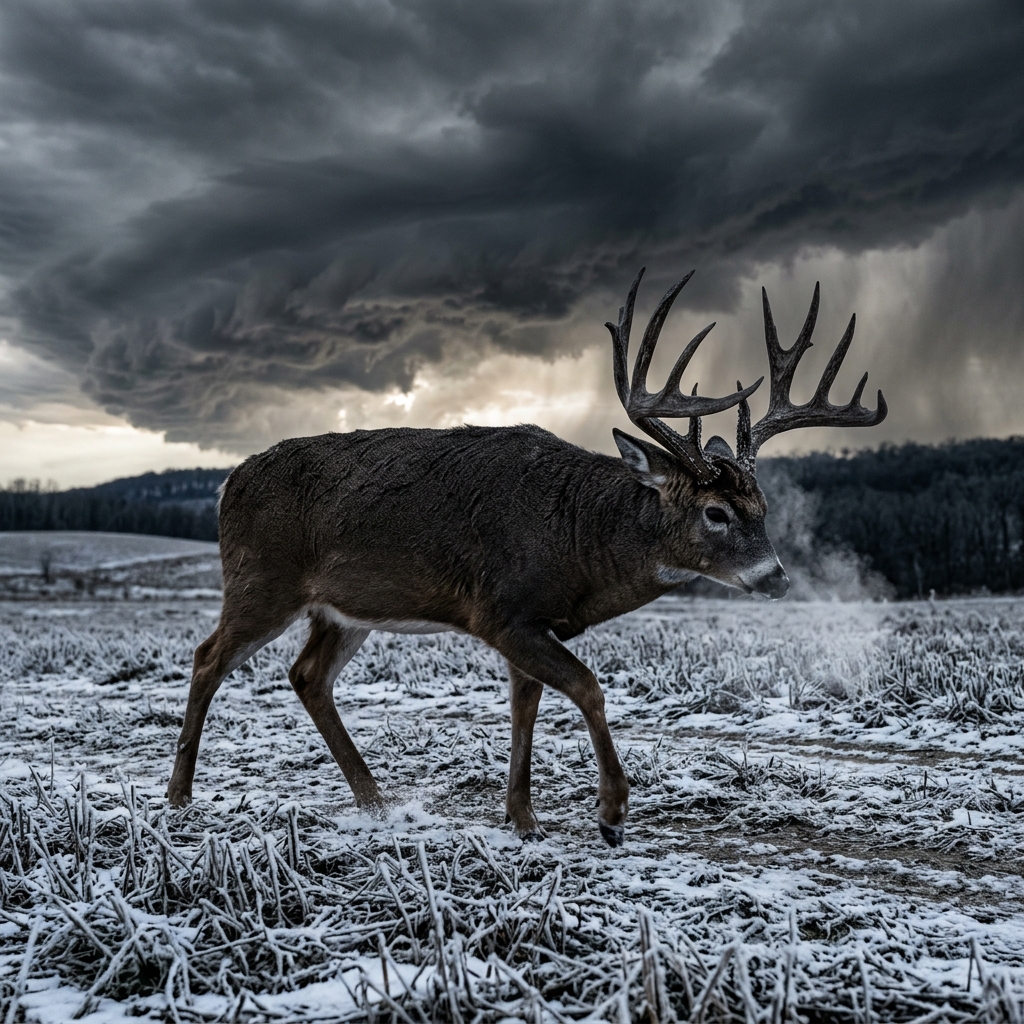
White-Tailed Deer Activity: Hunting the Mathematical Biology of Weather
Temperature drops, fronts, wind, and barometric swings drive mature buck movement. Learn which weather windows to hunt—and which to sit out safely.
Bad weather is not an automatic reason to stay home. For whitetails, fronts, pressure swings, and sharp temperature drops are movement triggers—sometimes stronger than a calm bluebird day that feels perfect to a hunter.
At Wildsnap, we treat weather as a planning input, not a mood. Deer do not move randomly “because it’s nice.” They move when biology and comfort line up: feeding before a storm, shifting to leeward cover in wind, or responding to a hard cold snap after a warm stretch. Learn those windows and you stop hunting convenience and start hunting probability.
The hunters who consistently see daylight bucks are rarely luckier. They match stand choice to atmospheric conditions the night before, then execute even when the forecast looks miserable.
Why Weather Overrides “Normal” Patterns
Whitetails budget energy. A warm, stable week lets them feed mostly at night. A fast-moving system changes the math.
- Approaching storms encourage heavy feeding before conditions worsen
- Sharp cold snaps after mild weather increase daylight feeding demand
- High wind relocates deer to quieter topography rather than shutting them off entirely
- Fog and drizzle shrink scent cones and extend daylight security in open areas
Your job is not to hunt every ugly forecast. It is to recognize the 3–6 hour windows when odds spike.
Camera data often proves this. A property that shows zero daylight buck photos for ten days can produce three mature deer in one afternoon when a front arrives. The herd did not disappear—it was waiting for a trigger. Weather is that trigger more often than moon phase, rut calendar dates, or blind hope.
For pressure-specific detail, pair this article with barometric pressure and deer movement.
Barometric Pressure and the Pre-Front Window
Many hunters wait for the pretty high-pressure day after a storm. That can be good—especially late season on food. Often better is the vanguard: the hours as pressure falls ahead of the front.
Practical benchmarks many hunters track:
- Watch trends more than a single number
- Rapid drops toward and below roughly 29.90 inHg often precede storms
- The final 2–4 hours before hard rain or snow frequently produce aggressive feeding
Deer sense atmospheric change early. They do not need radar. When the woods feel “charged” and clouds build, primary food and staging edges can light up in daylight.
After the front: Rising pressure with clearing skies is classic for afternoon sits on calories—corn, beans, brassicas, oak flats—especially if temperatures also fall.
Track pressure hourly, not daily. A drop from 30.10 to 29.95 over six hours means something different than the same net change over two days. The rate of change correlates with urgency. Pair pressure data with wind direction: a falling barometer with a strengthening northwest wind in October is a hunt-day signal in most whitetail range.
Temperature Swings and Flash Cooling
Absolute temperature matters less than change.
A drop of 10–20°F in a few hours after a warm spell is a proven daylight trigger in many regions. Bucks that were nearly nocturnal suddenly show on cameras and trails.
How to use it:
- Note the warm baseline (example: mid-60s evenings in October)
- Watch for a forecasted plunge into the 40s with northwest wind
- Sit food-to-cover edges and known staging areas the afternoon the drop arrives—not three days later when the herd has already adjusted
Conversely, a sudden warm-up after bitter cold can suppress midday movement and push feeding later. Adjust sit length and location rather than forcing the same stand.
In late season, a cold snap after a thaw can pull deer to standing crops and south-facing edges within hours. In early season, the first sharp overnight drop into the 40s after weeks of warmth often triggers the first serious daylight buck movement of the year. Write down the temperature delta from your weather app and compare it to camera results over a season—you will build a local playbook fast.
See hunting in unseasonably warm weather for the opposite problem.
Wind: Relocation, Not Shutdown
The myth says deer lock down above 15 mph. Reality: they change geography.
In sustained 15–25+ mph winds, expect deer on the leeward (downwind-protected) sides of ridges, hills, and timber blocks. They seek acoustic pockets where roaring canopy noise drops enough to hear again, and where terrain helps scenting.
- Avoid open ridgetops and bald field edges in a gale
- Drop onto protected slopes and creek bottoms with cover
- Still-hunt leeward benches when stands feel unsafe
Wind direction matters as much as speed. A 12 mph west wind on an east-facing slope may be huntable; the same speed on an exposed ridge is not. Map leeward pockets on your property before the season: creek bottoms, east slopes in westerlies, timber behind berms, and the downwind side of hills.
Deep dive tactics live in high wind whitetail tactics. For wet, quiet conditions that favor stalking, see hunting in fog and drizzle.
Rain, Drizzle, and Post-Storm Feeding
Light drizzle often helps hunters: quieter leaves, softer entry, deer willing to move. Hard downpours usually pause movement; the bite comes on either side.
| Condition | Typical deer response | Hunter move |
|---|---|---|
| Light drizzle / mist | Secure movement, good stalking | Soft edges, still-hunt bedding fringes |
| Steady moderate rain | Reduced long travel | Food sources near thick cover |
| Violent storm core | Bedded tight | Stay safe; prepare for the break |
| First clear hours after | Strong feeding | Primary food, short entry routes |
Do not confuse “deer hate rain” with “deer hate all wet weather.” Intensity and timing decide everything.
The first two hours after rain stops can be explosive. Deer that held tight during the downpour often feed aggressively once the noise drops and visibility returns. Be in position before the sky clears, not after you see sunshine from the truck.
Thermals, Fog, and Microclimate Effects
Weather on your phone is rarely weather in your stand. Valleys pool cold air at dawn; ridges heat and pull thermals uphill by mid-morning. A 45°F forecast at the trailhead can mean 38°F in a creek bottom at first light.
Fog compresses scent and sound. Deer move more confidently in open areas they normally avoid in daylight. Still-hunt foggy field edges and transition seams with extra caution—you will hear deer later than usual.
Lake and river effects extend fog and delay wind shifts near large water. A property five miles from a major lake may stay foggy an hour longer than inland ground.
Understanding local thermals pairs with understanding thermals for stand placement on slope and valley properties.
Building a Simple Weather Hunt Plan
Use a one-page checklist the night before:
- Pressure trend: rising, falling, or flat?
- Temperature delta: how many degrees in 12 hours?
- Wind: speed + direction + which leeward pockets it creates on your map
- Precipitation type: drizzle vs washout
- Stand shortlist: 2–3 spots that match that wind and food stage
If none of your stands fit the wind, do not force a bad sit. Walk a leeward route or glass from a distance. A wrong-wind sit educates more deer than it kills.
Weather apps help, but local microclimate beats a regional icon. Ridges, valleys, and large lakes create their own wind and fog patterns—learn yours.
Keep a simple log: date, pressure trend, temp swing, wind, stand hunted, deer seen. After one season you will know which combinations actually produce on your ground—not generic internet rules.
Gear and Safety When Hunting Fronts
Hunting the edge of weather only works if you stay functional.
- Rain-induced hypothermia hits hard in 45–55°F wet wind—often faster than dry cold in the teens. Quiet waterproof shells and non-cotton layers are mandatory. See cold weather layering.
- Lightning: Leave elevated metal stands if thunder follows flash closely. Do not shelter under lone field trees.
- Access: Muddy creek crossings and slick leaf litter cause more injuries than “toughing out” a storm.
- Exit plan: Know how you leave if rain turns to ice or wind exceeds safe stand limits (~20–25 mph sustained for many setups).
Pack a dry bag with an extra mid-layer and gloves. Shivering ruins shot execution and judgment. If you cannot stay quiet and warm, shorten the sit rather than white-knuckling through a front.
Frequently Asked Questions
Is a rising barometer always best? Rising pressure after a front is excellent, especially on food. Falling pressure before a storm can be equally productive for short feeding bursts. Hunt the trend and the timing, not a slogan.
What wind speed should cancel a hunt? Tree stands become hazardous for many hunters around sustained 20–25 mph, with gusts higher. Deer may still move on the leeward side—switch to ground tactics or safer terrain.
Do deer move in the middle of a thunderstorm? Usually little purposeful travel during the worst electrical and wind core. Focus on the hours before and after.
How much temperature drop is “enough”? A noticeable swing—often 10°F+ in half a day—matters more than hitting a magic number. Context against the prior week is key.
Should I trust solunar tables over weather? Use weather and wind first. Solunar can be a tie-breaker on similar days, not a replacement for fronts and pressure.
Can phones replace a dedicated weather plan? Phones are fine for forecasts. Still write stand choices tied to wind direction before you leave—so a push notification does not talk you into a bad tree.
Matias Schiestl, Co-Founder
Matias plans hunts around atmospheric shifts—pressure, temperature, and wind—because those patterns explain daylight buck movement better than hoping for perfect bluebird skies.
Know which conditions actually trigger daytime activity
Connect your cameras and see which conditions really trigger movement — not guesswork.
No credit card
Wildsnap • Open beta
Know which conditions actually trigger daytime activity
Connect your cameras and see which conditions really trigger movement — not guesswork.
No credit card