
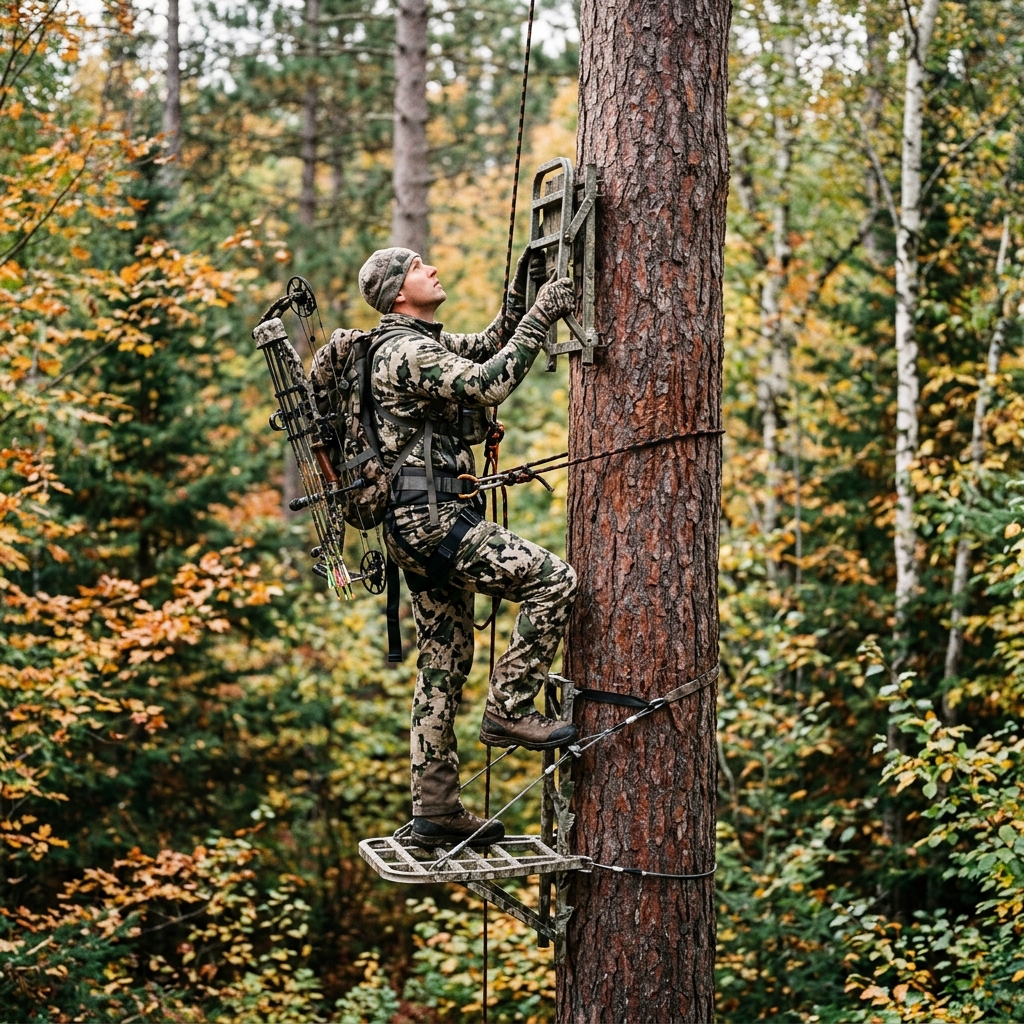
Using a Climbing Tree Stand: Safety and Ascending Techniques
Learn how to use a climbing tree stand safely—tree selection, inchworm ascent, connector straps, haul lines, and descent tips for public land.
For the public-land hunter, a climbing tree stand is mobility gear: pack in, set up on fresh sign, and hunt where last night’s tracks say the buck is living. Success isn’t only reaching 20 feet—it’s ascending quietly, staying tethered, and getting down in the dark without becoming a statistic.
Falls remain one of the top serious hunting injuries. Treat the climber like a system, not a seat.
Why Use a Climbing Stand Instead of a Hang-On?
Climbers shine when you need same-day adaptation:
- Fresh rub line discovered at 2 p.m.
- Public land where leaving hang-ons invites theft
- Flooding or crop harvest that shifts deer overnight
Tradeoffs:
- Heavier than a saddle kit (often 20–30+ lb for stand + platform)
- Require straighter trunks free of lower limbs
- Louder than a practiced saddle setup if your technique is sloppy
If you prefer minimalist mobility, compare with Mastering Saddle Hunting. For harness fundamentals that apply to every elevated hunt, read Tree Stand Safety: Harness and Lifelines.
How Does the Inchworm Climb Actually Work?
Climbing is a controlled inchworm:
- Attach and set teeth on the base of the tree at ground level.
- Sit/stand to move the seat section up; lock teeth into bark.
- Move the platform up to meet it.
- Repeat in short, secure bites—typically 12–18 inches per cycle.
High-torque seating: Before trusting full weight, give each section a firm tug or kick to bed the teeth. Shallow bites on hard bark are failure points.
Rhythm tips:
- Keep your center of gravity close to the trunk
- Pause if bark starts to “sheet” or crumble
- Don’t rush the last 5 feet—fatigue causes sloppy bites
Target hunting height is often 17–22 feet to the platform on public timber, adjusted for cover and shot lanes.
What Is the Connector Strap and Why Is It Non-Negotiable?
The strap linking the top and bottom sections is your failsafe—call it a life-link if it helps you remember.
If the platform slips at 20 feet and you’re not connected, you can be left hanging in a harness with no standing platform and a nightmare descent. Always:
- Use the manufacturer connector
- Inspect stitching and buckles before every hunt
- Adjust length so sections can’t separate beyond recovery
Never remove it to “climb faster.”
Which Trees Are Safe for Climbers?
Not every trunk is climber-friendly.
Good candidates:
- Straight pines and cedars with biteable bark
- Young oaks with texture
- Diameters roughly 8–16 inches at platform height (check your stand’s rating)
Avoid or use extreme caution:
- Wet aspen/poplar — slick as ice after rain
- Shagbark hickory — plates can shell off under teeth
- Dead or hollow trees — structural failure risk
- Trees with carpenter ant frass, fungal conks, or large dead crowns
- Leaning trees that force uneven tooth pressure
Clear small dead limbs on the way up only if you can do it without unsafe one-handing. Better: pick a cleaner tree 10 yards away.
How Do You Stay Safe With a Harness and Haul Line?
Rules that prevent funerals:
- Wear a full-body harness from the moment you leave the ground.
- Stay connected to the tree during ascent and descent (lineman’s belt / climbing system as designed).
- Never climb with a bow or rifle on your person.
- Use a haul line rated for your weapon; attach the firearm unloaded / arrow nocked only when safe and legal practice allows—many hunters haul bows with arrows in a quiver, not nocked.
- Attach your tether before you settle in to hunt.
Practice at 6–8 feet near the truck before you invent technique in the dark on opening morning.
Pack a haul-line carabiner, backup strap, and headlamp with fresh batteries. For broader elevated-hunt safety culture, revisit Tree Stand Safety: Harness and Lifelines.
How Do You Descend Quietly After Dark?
Most accidents happen going down—cold hands, iced platforms, impatience.
- Haul weapons down first and stage them safely away from the trunk base.
- Keep tether/lineman connection as you reverse the inchworm.
- Take shorter bites when fatigued.
- Watch for frozen mud on boot platforms—scrape traction cleats.
- Once on the ground, disconnect deliberately; don’t stumble out of the harness still clipped.
If weather turns to freezing rain, consider ending the hunt early. Pride isn’t worth a 20-foot drop.
What Pack Setup Works Best With a Climber?
Keep the load tight:
- Stand on a pack frame or lashed vertically so hands stay free for hiking
- Soft goods (seat cushion, pull-up rope) secured so nothing bangs the trunk
- Minimal metal-on-metal—tape buckles if needed
Public-land loops of 1–3 miles are common. If you’re also packing meat out, plan a second trip or a frame pack swap—see Choosing a Hunting Pack. For kill-kit organization that fits climber hangs, use How to Pack a Hunting Kill Kit.
How Do You Stay Quiet While Climbing?
Speed is useless if every bite rings like a xylophone.
Quiet-climb habits:
- Wrap metal-on-metal contact points with athletic tape or moleskin
- Clear crunchy leaves from boot platforms before leaving the ground
- Climb in soft soles; switch to stiffer boots only if ice demands it
- Pause 30 seconds every few cycles to listen—deer often bust noise, not silhouettes
- Avoid climbing dead bark that showers down like applause
Practice the full sequence at home height until you can ascend 15 feet in under 6 minutes without looking at buckles. Muscle memory keeps you safe when gloves are stiff at 18°F.
If you bump a deer while climbing, freeze mid-tree only if you’re already tethered and stable. Otherwise, quietly reverse to the ground and abort—hanging in limbo while a buck stamps and blows rarely ends with a shot.
What Backup Gear Belongs on Every Climber Hunt?
Minimum redundancy:
- Extra tree strap / tether component rated for your system
- Haul line long enough for your max height + 10 feet
- Folding saw for a single obstructing limb (not a logging project)
- Headlamp + spare batteries
- Phone in a chest pocket for emergency location sharing
Optional but smart: a short sections of rope for emergency platform retrieval scenarios, and a small first-aid kit with trauma shears. If you hunt alone more than a mile from the truck, a satellite messenger earns its fee the first time a knee goes wrong on the descent.
How Do You Hunt Fresh Sign Without Getting Reckless?
Climbers tempt you to chase every smoking rub line into a bad tree. Use a decision filter:
- Is the trunk straight, alive, and within your diameter rating?
- Can you stay connected for the entire ascent?
- Do you have a wind that works after you reach height—not just at the truck?
- Are you at least past legal light requirements for your weapon if you’re cutting it close?
If any answer is no, walk. The climber’s advantage is mobility across good trees, not stubbornness on a death trap. Public-land bucks will be there tomorrow; your spine needs to be too.
When you do commit, stage the climb so the noisiest section (clearing lower dead limbs) happens farthest from bedding, then finish the last 10 feet with deliberate, quiet bites.
One more non-negotiable: if ice coats the platform, scrap the hunt or switch to a safer ground option. Cleats help, but frozen mud on mesh platforms remains one of the most common climber slip conditions after a thaw-freeze night.
Frequently Asked Questions
How long does it take to climb 20 feet?
With practice, 4–8 minutes including safety checks. Beginners may need 15. Quiet beats fast.
Can I use a climber on a crooked tree?
Mild crooks are possible; severe bends prevent even tooth engagement. Walk to a straighter trunk—don’t force it.
What’s better in steep country—climber or saddle?
Saddles win on limb-heavy or crooked timber. Climbers win on tall, straight pines with open trunks. Many hunters own both.
Do I need to replace climbing stands periodically?
Inspect every season. Replace if teeth are rounded off, cables fray, welds crack, or platforms warp. Follow manufacturer retirement guidance after impacts.
Is a climbing stand safe for youth hunters?
Only with close adult coaching, lower heights, and perfect harness habits. Many families start kids in lock-ons with lifelines before climbers.
Bed the teeth, trust the connector, haul the weapon, and stay clipped from dirt to dirt. A climber makes you mobile—safety systems make sure you get to hunt tomorrow.