
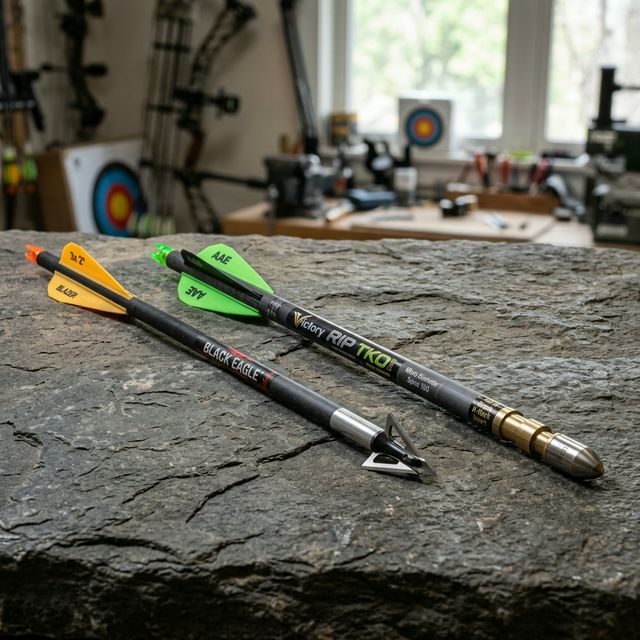
Heavy Arrows vs. Light Arrows: FOC, Momentum, and Lethality
Speed vs penetration for bowhunting: compare arrow weight, kinetic energy, momentum, and FOC so your setup delivers ethical pass-throughs on whitetails.
No archery topic splits pro shops faster than total arrow weight. Speed chasers want flat trajectory and chronograph bragging rights. Momentum hunters want bone-crushing penetration when a 200-pound buck quarters slightly or the shoulder is tighter than planned.
Physics settles more of the argument than brand loyalty. Kinetic energy loves velocity; penetration in animals loves momentum and structural toughness. A light, fast arrow can look great on foam and still stall on heavy bone. Build for the animal, not only the target butt. Pair this with solid shot placement, honest distance judgment, and a release you shoot consistently—see archery releases.
Kinetic Energy vs Momentum
- Kinetic energy (KE) scales with velocity squared. Light-and-fast builds can post high KE numbers on paper.
- Momentum scales with mass × velocity. It better predicts how far an arrow pushes through hide, muscle, and bone before stopping.
Ping-pong ball at high speed: energy without lasting penetration. Bowling ball at modest speed: lower “wow” energy, serious momentum. Whitetail hunting rewards the bowling-ball side of that analogy—especially with fixed-blade broadheads and less-than-perfect angles.
KE still matters as a floor for ethical setups, but chasing KE with ultra-light arrows often trades away the penetration you need on impact. Most bowhunters shooting whitetails inside 40 yards should prioritize momentum and arrow integrity over maximum feet-per-second. A 450-grain arrow at 260 fps often outperforms a 350-grain arrow at 310 fps when the hit is not textbook.
Choosing Total Arrow Weight
Use GPI (grains per inch) plus insert, broadhead, vanes, and nock to hit a finished weight. Weigh the complete arrow on a grain scale—do not guess from shaft specs alone.
Light / fast builds (under ~400 grains)
- Flatter trajectory to 40 yards and beyond
- Helpful when long western shots make a 3-yard range error costly
- More speed can mean more string jump risk if the bow is louder and the deer reacts
- Higher chance of stopping or deflecting on heavy bone, especially with marginal shot angles
Mid builds (~400–450 grains)
- Common compromise for many Eastern bowhunters
- Manageable arc with improved forgiveness over ultra-light setups
- Works well with tuned mechanical broadheads at moderate draw weights
Heavy builds (~450–550+ grains)
- Strong momentum for pass-throughs on quartering and shoulder-adjacent hits
- Often quieter bows—more mass absorbs energy, cutting vibration and noise
- Steeper arc requires better ranging discipline inside timber
For most whitetail woods hunting inside 30–40 yards, a finished arrow in the 450–500+ grain class with a tough broadhead is a practical lethal standard. Adjust for your draw weight and ethical range. If you shoot 50 pounds or less, stay inside the heavy end of mid-weight rather than stacking so much mass that flight turns sluggish.
FOC: Front of Center Balance
FOC measures how far forward of center the balance point sits. Formula in plain terms: find the balance point, compare to arrow midpoint, express as a percentage of arrow length.
- Traditional target FOC often sits near 7–9%
- Hunting builds commonly improve at 11–15%
- High FOC setups run 13–18%+ with heavy inserts (50–100 grains) behind the broadhead
Why high FOC helps
Weight up front steers like a lawn dart. The shaft follows the point, improving stability in crosswinds and forgiving minor form errors. Fixed blades especially benefit from forward weight and spin. When a buck steps behind a sapling at the shot and you catch a little front shoulder, high FOC keeps the broadhead driving rather than planing off bone.
Helical fletching
A 2–3° helical (or quality offset) spins the arrow for gyroscopic stability. Pair helical vanes with high FOC and fixed blades for consistent flight after broadhead tuning. Straight vanes can work on short, heavy setups, but helical is the safer default for hunting heads.
Spine, Draw Weight, and Arrow Length
Wrong spine ruins every FOC and weight decision. Spine refers to how much the shaft flexes at launch. Too weak and the arrow oscillates wildly; too stiff and it may not recover before impact.
Match spine charts to your draw weight, draw length, and point weight (broadhead plus insert). Adding 100 grains up front often requires dropping to a weaker spine or shortening the shaft. A shop paper tune is worth more than internet forum advice—especially when you change insert weight or switch from 100- to 125-grain heads.
Longer arrows add weight and can stiffen effective spine. If you cut shafts for a shorter draw, recalculate finished weight and FOC before you assume your old setup still tunes clean.
Building a Practical Hunting Arrow
Step-by-step:
- Pick a spine matched to your draw weight and arrow length—wrong spine ruins FOC benefits.
- Choose shaft GPI to leave room for a heavy insert without oversized finished weight for your bow.
- Add brass or steel inserts to raise FOC without going so heavy that fps drops below your ethical minimum.
- Mount a durable broadhead (fixed or well-tuned mechanical) at your ethical range—see fixed vs mechanical broadheads for tradeoffs.
- Fletch helical; paper-tune and walk-back tune until groups are boring at hunting distances.
- Chronograph if you want data; prioritize quiet groups and penetration tests on dense targets over max fps.
If you also shoot a crossbow season, remember bolts are a different mass/speed system—see crossbow vs compound.
Trajectory Tradeoffs and Practice
Heavier arrows drop more. That is manageable if you:
- Pre-range landmarks around the stand
- Practice odd yardages (27, 33, 37) not only 20/30/40
- Know your pin gaps cold
- Cap your shot distance to what you shoot clean under stress
A quiet 480-grain arrow at 28 yards beats a screaming 350-grain arrow at “maybe 42” when the buck steps into a hole in the leaves. Range finders help, but timber hunting rewards memorized yardages on specific trees and stumps. Run through those numbers in August when leaves are still up—not opening morning when adrenaline spikes.
Broadheads and Structural Toughness
Momentum without a tough point still fails. Single-bevel and quality cut-on-contact fixed heads shine on bone when flight is true. Mechanical heads can work with enough momentum and open reliably—test yours at hunting speeds on layered foam or a fresh shoulder blade, not only a bag target.
Match head weight to your FOC plan (100–125 grains is common; some push 150+ for extreme FOC). Retune every time you change front mass. A head that grouped at 100 grains may fly differently at 125—expect to move rest or nock point.
Carbon Arrow Safety: Flex Test
Carbon fails differently than aluminum. Micro-cracks from rocks, tree hits, or arrow-on-arrow impacts may be invisible.
After hard impacts:
- Flex the shaft in an arc near your ear.
- Listen for crackling; look for splinters or dull spots.
- Retire any questionable arrow immediately.
Firing a cracked carbon out of a 60–70 lb bow can explode the shaft into your hand. Never dry-fire; never shoot damaged carbon. Rotate hunting arrows and inspect vanes and nocks after every recovery—blood and dirt hide hairline damage.
Real-World Penetration Scenarios
Whitetail hits are rarely perfect broadside at 20 yards. Quartering-away shots favor heavy setups because the arrow must traverse more tissue. Quartering-toward hits punish light arrows on the near shoulder. Heavy momentum does not forgive bad shot selection—it just gives you margin when the deer shifts a step at release.
Track recovered arrows when legal and safe. A pass-through with the head buried in the off-side dirt tells a different story than an arrow stopped under the far shoulder. That feedback loop beats any calculator.
Frequently Asked Questions
Will a heavier arrow kill my effective range? It shortens the distance where small ranging errors still hit the vitals. Inside typical whitetail bow range, the penetration gain is usually worth the steeper arc if you practice odd yardages.
Is 500 grains too heavy for a 60-pound bow? Often no—if spine is correct and you can tune. Extremely heavy builds on low draw weight may yield sluggish flight; get a shop to check spine and FOC.
Do mechanical broadheads need lighter arrows? They need reliable opening energy and enough momentum to drive after opening. Do not assume light-and-fast is required—test your head on your setup at hunting speed.
How do I measure FOC at home? Balance the arrow on a thin edge, measure from nock throat to balance point, compare to center of the arrow’s length, and apply the standard FOC percentage formula from the manufacturer or Archery Trade materials.
Does heavier always mean quieter? Generally more mass reduces leftover vibration, which helps. Bow tune, rest contact, and cam timing still matter. Weight is one lever, not the only one.
Should I switch arrow weight mid-season? Avoid it unless you have time to retune and shoot a full practice session. A last-minute grain change without tuning has cost more deer than any “magic” weight ever saved.
Flat trajectory impresses at the range. Momentum and a tough, well-tuned point recover deer. Build the arrow for the hit you might actually get—not the perfect foam pass-through.
Wildsnap • Open beta
Join Wildsnap and try the beta
In the open beta, you turn trail-cam data into actionable insights—free, fast, and simple.
No credit card